

Marchas Das Mulheres Negras (Black Women’s March) 2025’s Economic Justice Manifesto is a political document prepared by over 300 Black women from across Brazil, articulating comprehensive demands for economic justice grounded in reparations and Buen Vivir – a philosophy of good living rooted in Andean Indigenous worldviews. Launched ahead of the November 25, 2025 march, the manifesto serves as a blueprint for transforming Brazil’s economy to center Black women whose labor has historically sustained the nation while remaining economically marginalized.
The manifesto is grounded in stark realities: 63% of households headed by Black women live below the poverty line; nearly half work without formal labour rights; nearly 80% of women nationally carry debt incurred for survival. Black women workers across sectors – domestic labor, farming, nursing, teaching, street vending, and community leadership – sustain Brazil daily while facing disproportionate harm from food insecurity, unemployment, predatory debt, violence, and environmental degradation. In other words, the Brazilian economy was built on expropriated Black labour and territories, yet continues to deny them recognition and security.
The Manifesto intertwines two demands: historical reparations and Buen Vivir. Reparations require public acknowledgment of Brazil’s historical debt from slavery and ongoing structural racism, alongside concrete redistributive measures: progressive taxation on large fortunes, a permanent National Fund for Economic Reparations with Black women’s leadership, affirmative action with dedicated budgets, land titling for quilombola communities, and institutional accountability. Buen Vivir represents a civilizational shift toward economies organized around life, care, and community rather than profit and extractivism. Together, they correct historical injustice while reimagining economic relations based on dignity, solidarity, and environmental sustainability.
The manifesto structures demands across seven strategic axes:
Axis 1 (Economic and Institutional Reparations) proposes progressive taxation, a permanent reparation fund managed by Black women, accountability mechanisms for institutions profiting from slavery, and expanded affirmative action.
Axis 2 (Work and Income) demands salary equity by race and gender, expanded social security with modified retirement ages for Black women, regulation of occupations dominated by Black women, formal recognition of care work as foundational, and protections against labour exploitation and patrimonial violence.
Axis 3 (Macroeconomic and Fiscal Policy) calls for lower interest rates to reduce debt burdens, easier access to fair credit, protection of social budgets from austerity, redirection of subsidies toward popular goods and services, and race- and gender-sensitive public budgeting.
Axis 4 (Dignity) asserts fundamental rights: distributed land with quilombola territory titling, safe housing through targeted programs, healthy food as a guaranteed right, universal water and sanitation access, accessible transportation, demilitarized public security, anti-racist public health, and reformed social assistance.
Axis 5 (Public Investment) proposes dedicated funds for Black women entrepreneurs, democratised credit, reservation of state purchasing power for Black women-led businesses, climate justice financing for vulnerable communities, and transparent investment data disaggregated by race and gender.
Axis 6 (Private Sector Accountability) demands companies acknowledge historical debt through profit conversion to Black women’s projects, direct procurement from Black women-led businesses, philanthropic commitment with Black women’s leadership, and support for traditional and terreiro economies.
Axis 7 (International Financial Architecture) calls for restructuring the international financial architecture to include Global South and Black feminist leadership, promotion of feminist and community economies, decolonization of trade rules, de-dollarization, regulation of extractive foreign investments, and dedicated international advocacy funding.
Underlying all axes is a commitment to participatory democracy where Black women hold decision-making power over policies affecting them. The manifesto rejects technocratic development approaches, positioning itself as an evolving starting point rather than final blueprint. It honors diverse knowledge systems – from scientific expertise to ancestral and community wisdom – emphasizing that economic transformation is inseparable from cultural, political, and spiritual liberation rooted in Black women’s experiences across Brazil’s territories, from quilombos to urban peripheries, rural communities to city centers, and traditional sacred spaces to formal institutions.
The manifesto ultimately declares: Black women stand together, alive, and are building better futures.
Summary by Hailey Kaas
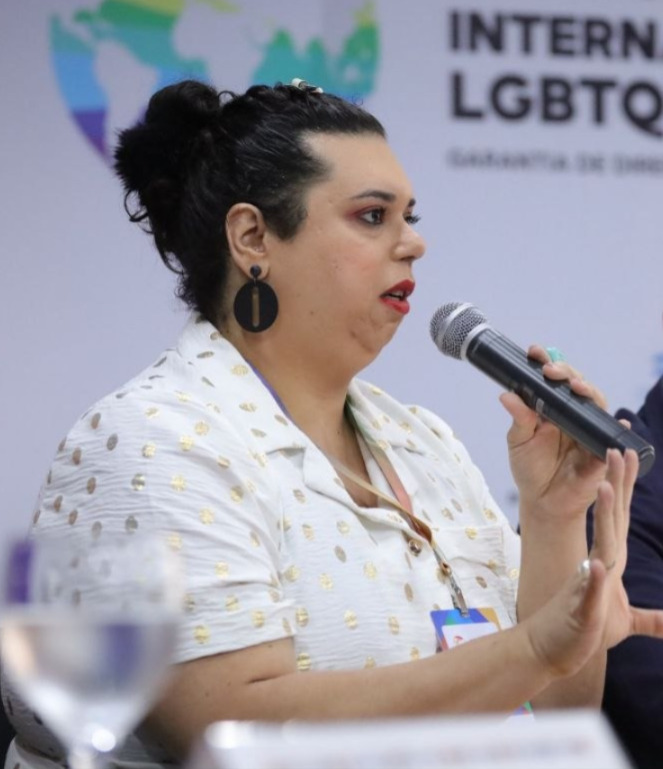
Hailey Kaas is a Latinx travesti, anthropologist, born in São Paulo, Brazil. She has been working for more than a decade in the fields of LGBTQIAP+ rights, women’s rights, and racial justice. Currently, she is the director of the CPT – Centro de Pesquisa Transfeminista (Transfeminist Research Center), a small organization dedicated to producing and promoting research/data primarily related to trans people in Brazil. She is also a graduate student at the University of São Paulo (USP), working towards a master’s degree in Humanities, Rights, and other Legitimacies.
Liked this article? Share it!


