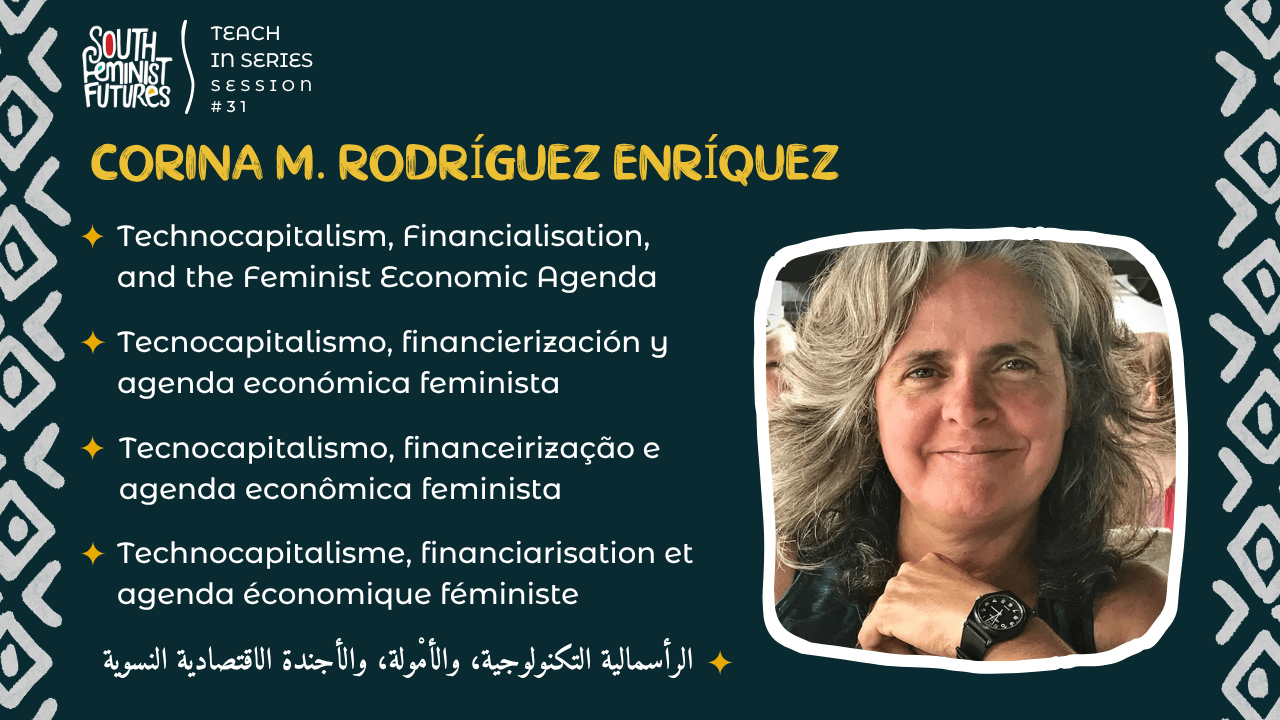
On March 26th, 2026, we held the 31st session of our Political Economy Teach-in Series: “Technocapitalism, Financialisation, and the Feminist Economic Agenda” with Corina M. Rodríguez Enríquez.
This session aimed to share an analytical framework from a Global South feminist perspective to understand the logic of contemporary capitalism and its implications for the reproduction of inequality and the constraints imposed on the life projects of the majority. Drawing on the lessons of DAWN’s Feminist Macroeconomics project the discussion addressed the central features of the current stage of global capitalism: the dominance of finance, its decoupling from the real economy, the emergence of a technofinancial economic elite, corporate power over states and development agenda, and renewed mechanisms for extracting resources from the Global South. The session also reflected on the links between these trends, the delegitimisation of democracy, and the expansion of authoritarian political options. Finally, it will propose several elements for thinking about how to organise a feminist economic agenda that is able to confront and transform these dynamics.
Corina M. Rodríguez Enríquez works from a feminist economics perspective on fiscal policy, debt, and the social organization of care. She currently coordinates the Feminist Macroeconomics Project at DAWN and serves as a member of its Executive Committee. She holds a degree in Economics from the University of Buenos Aires, an MA in Public Policy from the Institute of Social Studies (The Hague, The Netherlands), and a PhD in Social Sciences from FLACSO (Argentina). She is a researcher at the National Scientific and Technical Research Council (CONICET) and at the Interdisciplinary Centre for the Study of Public Policy (CIEPP) in Buenos Aires, Argentina. She also co-directs the PhD Program in Political Economy at the Interdisciplinary School of Social Studies, National University of San Martín (IDAES-UNSAM).
Our South Feminist Political Economy Teach-in Series aims to strengthen intergenerational dialogue and build a cross-regional feminist constituency. The series covers various topics to interrogate and strengthen understanding of issues shaping conditions in the Global South.
We have curated a special reading list of resources on the topic of this session, available on our South Feminist Knowledge Hub. It is designed to deepen your understanding of the themes and inspire meaningful discussion – featuring powerful contributions from authors and thinkers across the Global South.
Liked this article? Share it!


