
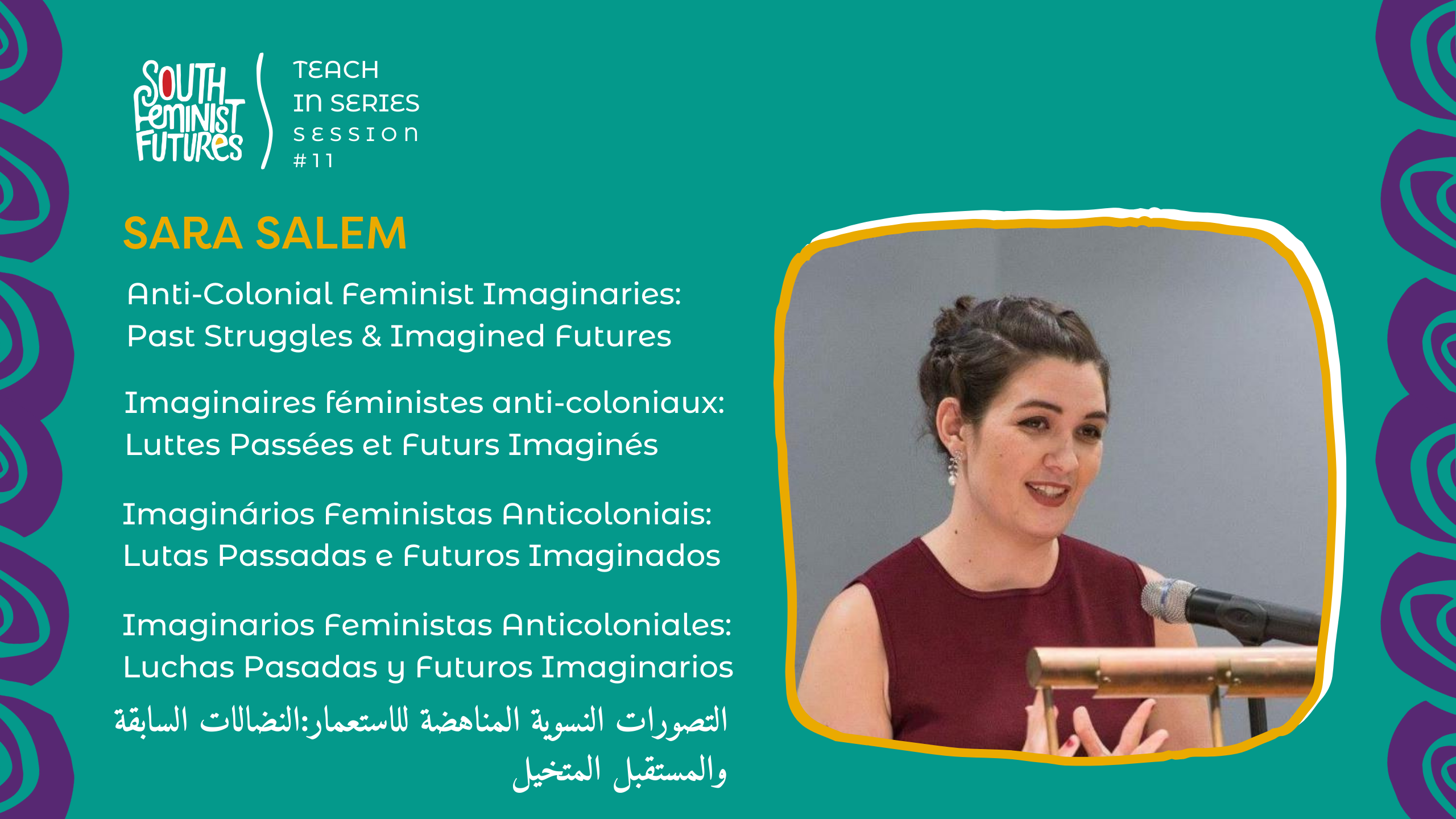
Anti-Colonial Feminist Imaginaries
In this teach-in, Sara offered a sweeping yet grounded account of anti-colonial politics – past and present. She began by reframing 20th-century history from a Global South perspective, arguing that it is liberation struggles, not world wars, that defined the era. From there, she traced the two pillars of anti-colonial thought: internationalist solidarity and anti-capitalism, before turning to the feminisms that grew within and against these movements. That second half of her talk explored how Third World feminists contested both Western feminism and patriarchy inside their own movements, why care work remains a central site of political struggle, and how feminist internationalism continues to animate organizing today. The discussion closed with reflections on technology and archiving: what it means to build and preserve collective memory in an age of surveillance.
Anti-Colonial Movements
Sara begins her talk by explaining why anti-colonialism has been gaining more traction in recent times. She first argues that while dominant histories center the wars of the 20th century as the main transformative events of that era, a Global South perspective tells us a different story: it is the liberation struggles against colonial powers that truly transformed our world. Recognizing this allows us to understand history differently and draw lessons from it for our current movements. She then notes that we are now living in the aftermath of those anti-colonial struggles, and that postcolonial states (many of which have become dictatorships) together with neoliberalism, have produced increasingly widespread inequalities. These contradictory legacies, she argues, call on us to understand anti-colonialism not as a fixed prescription but as a spirit guiding our efforts to imagine and build different futures. This spirit rests on two pillars: solidarity and internationalism, and anti-capitalism.
Solidarity movements and internationalism:
The anti-colonial movements of the 20th century devoted immense energy to cultivating international solidarity across borders and identity structures. This was reflected in the writings of that period and in the international conferences that brought together organisers and actors fighting for liberation. Quoting Vishay Prashad, Sara notes that “the Third World is a project, not a place”—a project in which diverse practices, relationships, and visions for the future came together across peoples and geographies. Sara also highlights that some of the struggles central to mid-century literature and archives, most notably those of Palestine and Congo,remain alive today. In doing so, she points to the continuity of movements across time, particularly in their shared resistance to Western power and extraction, and argues that internationalism is central to disrupting these structures. She adds, however, that tensions were present in these new internationalist spaces. For example, the unprecedented visibility of people of color in the Afro-Asian Conference in Bandung coexisted with contradictions of power: first, the conference was primarily attended by elite men, and second, Indonesia itself was pursuing a colonial project in West Papua at the time.
Anti-capitalism:
Sara explains that anti-capitalist and Marxist values were—and continue to be—central to many anti-colonial movements and postcolonial states. During this period, the Global South was drawn into the global economy through resource extraction and the vicious cycles of debt imposed by finance capitalism. These unequal trade relationships became the foundation of a new form of colonialism—one that relied on economic rather than legal power. Anti-capitalist models sought to break these cycles of dependency. Sara offers examples such as nationalizing industries, centralizing power in the state rather than the market, expanding free social services, and implementing land reform. However, the rise of neoliberalism in the 1970s—particularly during the Reagan and Thatcher era—acted as a counter-revolution against anti-colonialism and its attempts to move away from Western capitalist control.
Anti-colonial / Third World feminism
Sara then turns specifically to feminism within anti-colonial movements, centering four key ideas at the core of anti-colonial feminism: the struggle against Western feminism, the struggle against patriarchy, the political economy of care, and feminist internationalism—all of which are essential to envisioning anti-colonial feminist futures.
Against liberal feminism:
Anti-colonial feminism was deeply embedded in 20th century anti-colonial movements, and its positioning as Third World feminism reflected its struggle against hegemonic or universal feminism—that is, forms of feminism that uphold liberal and capitalist values such as the right to vote or to own property. At the time, Western feminists had direct ties to colonialism, and anti-colonial feminists recognised this complicity. Their movements emphasized difference as a source of strength and internationalism as central to solidarity, focusing on structural change rather than reform.
Against patriarchy:
In parallel, anti-colonial feminists also fought against patriarchy within anti-colonial movements. Many feminists active in these struggles have been marginalized in historical memory. Archives, figures, and documentation about them are difficult to find, contributing to a structural and historical erasure of their roles. Sara references a few of the archives she has encountered, such as Revolutionary Papers, and highlights the intersectional and internationalist principles reflected in them.
The political economy of care:
Thinking critically about care is important to any feminist analysis of capitalism. The notion of care work, and care as unpaid labour, has been debated since the Wages for Housework movement of the 70s, which asked: how would we value women’s care work if we treated it as paid labour? Building on this history, Marxist feminism raises further questions about social reproduction: if work produces labour, who produces the worker? Bringing in the feminist question of subjectivity, the effort to value women’s work also invites us to consider experience: how do many women actually experience the world, if we are to understand care work as unpaid labour? Sara argues that these questions remain deeply relevant, having resurfaced strongly after the Covid-19 pandemic. She also proposes that recognizing the entanglement between feminism and anti-capitalism, viewing the home as an internationalist space within global capitalism, and expanding our understanding of work and labor can help anti-colonial feminists imagine not only an anti-capitalist present but also radically different feminist futures.
Feminist internationalism:
Drawing extensively on Veronica Gago, Sara centers feminist internationalism as a key component of anti-colonial feminist movements. Feminists held several landmark conferences mid-century, and these were important turning points in breaking away from western movements and building their own spaces and alliances for liberation – rooted in the intersections between gender equality, decolonization, and anti-capitalism. Sara argues that feminism remains one of the most international movements today, and that South-South internationalism in particular is connected through shared experiences of global oppression and lineages of liberation. It is also grounded in situated (rather than universal) thinking, showing how localized experiences can themselves be internationalist when they forge connections between the local and the global. In this context, Sara also discusses the idea of feminist potencia: while we can learn from the anti-colonial feminists of the past, we cannot yet know what the future will look like—because we cannot imagine what we are capable of until we begin to act. Movements, she reminds us, exist in continuous transformation.
In this last part of her talk, Sara highlights feminist strikes as a way in which we can concretely think about and organise around feminist internationalism. She describes them as mobilizations that connect anti-colonialism with anti-capitalism and unite different groups of people towards a common political horizon.
Q&A topic: Technology and archiving
Sara reflects on how technology has made both connection and oppression through surveillance more possible. This is very relevant in thinking about how the past meets the future in anti-colonial feminist movements—in last century’s movements, surveillance was much more limited. Moreover, while connection has technically been made more possible, feelings of isolation are very prevalent. This contrasts with the feelings of unprecedented connection that anti-colonial movements brought about.
Sara also points out that despite these new technologies of connection, they have, in practice, not necessarily brought about forms of mobilization that were not already happening. As for archiving—something that Sara repeatedly shed light on during her talk—she discusses how our understanding of the archive is now expanding from its very narrow history, which confined archiving to state documents. She encourages organizers to archive, and, bringing the link back to technology, she notes that this endeavor requires us to think carefully about the politics and value of archiving: surveillance also means erasure, and companies and governments ultimately can control what content remains online.
Summary by: Talah Hassan
Liked this article? Share it!


