
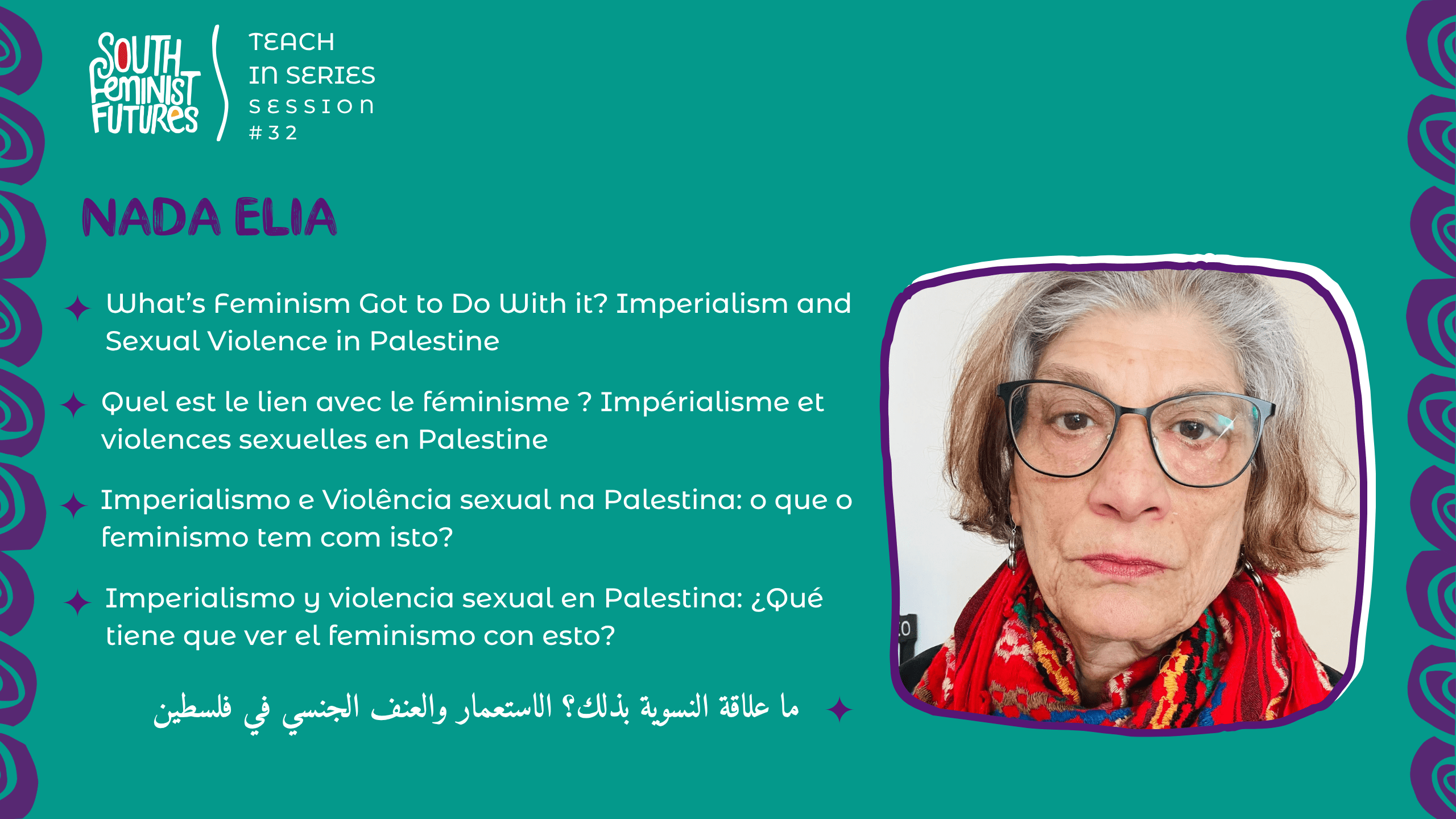
What’s Feminism Got to Do With It? Imperialism and Sexual Violence in Palestine
In her teach-in on colonial sexual violence, titled: “What’s Feminism Got to Do With It?”, Far Diaspora Palestinian scholar-activist and writer Nada Elia begins from a proposition that she argues should require no explanation: Palestine is a feminist issue. Speaking as a founding member of the Palestinian Feminist Collective (PFC), Elia situated Palestinian liberation within the struggle against systemic, gendered and colonial violence, oppression and dispossession. The PFC’s 2021 pledge asked women, feminist organizations, social and racial justice groups, and people of conscience to move beyond mere lip service by:
- Embracing Palestinian liberation as a critical feminist issue
- Defending Palestinian speech and political organizing
- Rejecting the conflation of anti-Zionism with antisemitism
- Endorsing Boycott, Divestment and Sanctions (BDS)
- Divesting from militarism
- and demanding an end to the US political, military and economic support for Israel.
Elia argues that many Global North feminist spaces remain shaped by “Zionism by default”: a framework that portrays Palestinians as aggressors, treats the Zionist occupation as permanently “defending itself,” and understands Palestinian women as oppressed exclusively by Arab patriarchy rather than by the all-pervasive violence of Zionism. She names this tendency “Feminists Except for Palestine,” or FEP, alongside “Progressives Except for Palestine.” In her account, Palestine exposes the limits of a feminism that stops at colonialism, occupation and genocide.
Against the false choice between national and gender liberation, Elia stresses Palestinian feminism’s long-standing understanding of “dual oppression” and “multiple jeopardy.” Drawing on the grassroots movement Tal’at, she repeats: “There is no free homeland without free women,” and “No to the imprisonment of our women in the occupation’s jails and in the jails of our oppressive society.” Palestinian feminists, she argues, have pursued social and political transformation together since the British Mandate. The PFC is a continuation of a century of Palestinian feminist organizing.
The session’s central claim is that Zionism, as a settler-colonial project, necessarily operates through gendered and sexual violence. Elia traces this violence from reported rapes during the Nakba, through the restriction of Palestinian midwifery after 1967, childbirth and newborn deaths at checkpoints, administrative detention, strip searches, rape threats and sexualized interrogation, to the siege and destruction of Gaza’s healthcare system. She describes sexual torture against women, men, children and gender-nonconforming Palestinians, including rape and castration, as institutionalized maltreatment used to extract confessions, terrorize communities, rupture social cohesion and dominate the Palestinian people.
Elia connects this violence to reproductive genocide: the targeting of Palestinians’ ability to reproduce and sustain collective life. Restrictions on midwives, blocked access to hospitals, attacks on pregnant women, the destruction of reproductive healthcare, and the sexual torture and castration of men form part of what she describes as Israel’s fixation on the Palestinian “demographic threat.” Sexual violence is therefore not incidental to colonial rule, but rather a means of controlling and eliminating the population.
Discussing the phrase al-ard qabl al-‘ird, “land before honor”, Elia acknowledges its role in refusing to let sexual violence destroy Palestinian collective struggle, while insisting that the association between rape and a survivor’s “honor” must itself be problematized. Sexual assault does not stain the survivor: “the fact that Israel is raping Palestinians is Israel’s dishonor, not our dishonor.”
Additionally, Elia exposes the silence and selectivity of Global North feminism. She distinguishes between acknowledging that individual acts of sexual violence may have occurred on 7 October and accepting allegations of a premeditated, systematic campaign, which she says has not been proven. She contrasts this with what she presents as extensive documentation of a systematic Israeli pattern of sexual violence dating from 1948 to the present. Outrage over allegations against Hamas that is not accompanied by outrage over documented Israeli violence, she argues, “does not stem from feminism, but from racism.” In this framework, feminism is weaponized to justify genocide, reproduce the trope of Palestinian men as savage sexual predators, and erase Indigenous testimony.
Elia also problematizes the repeated emphasis on “women and children.” While this framing supposedly appeals to feminist concern, it can infantilize women, deny women and children political agency, and imply that Palestinian men cannot be victims. Palestine, she insists, must be connected to disability justice, environmental justice, prison abolition, anti-racism, decolonization and anti-militarism because “just about every system of injustice is also happening in Palestine.”
The session ends with a call for grassroots internationalism. Solidarity must include political education, mutual aid, classes for students in Gaza, attention to women’s material needs in aid packages, demilitarization and pressure on leaders to reflect grassroots politics. Elia’s concluding insistence is that settler colonialism is “an ongoing structure, not an event”; what began in 1948 did not end, and what followed 7 October 2023 is an “intensified” or accelerated genocide. Palestine must not recede from feminist consciousness, and the genocide is certainly not over.
Liked this article? Share it!


