
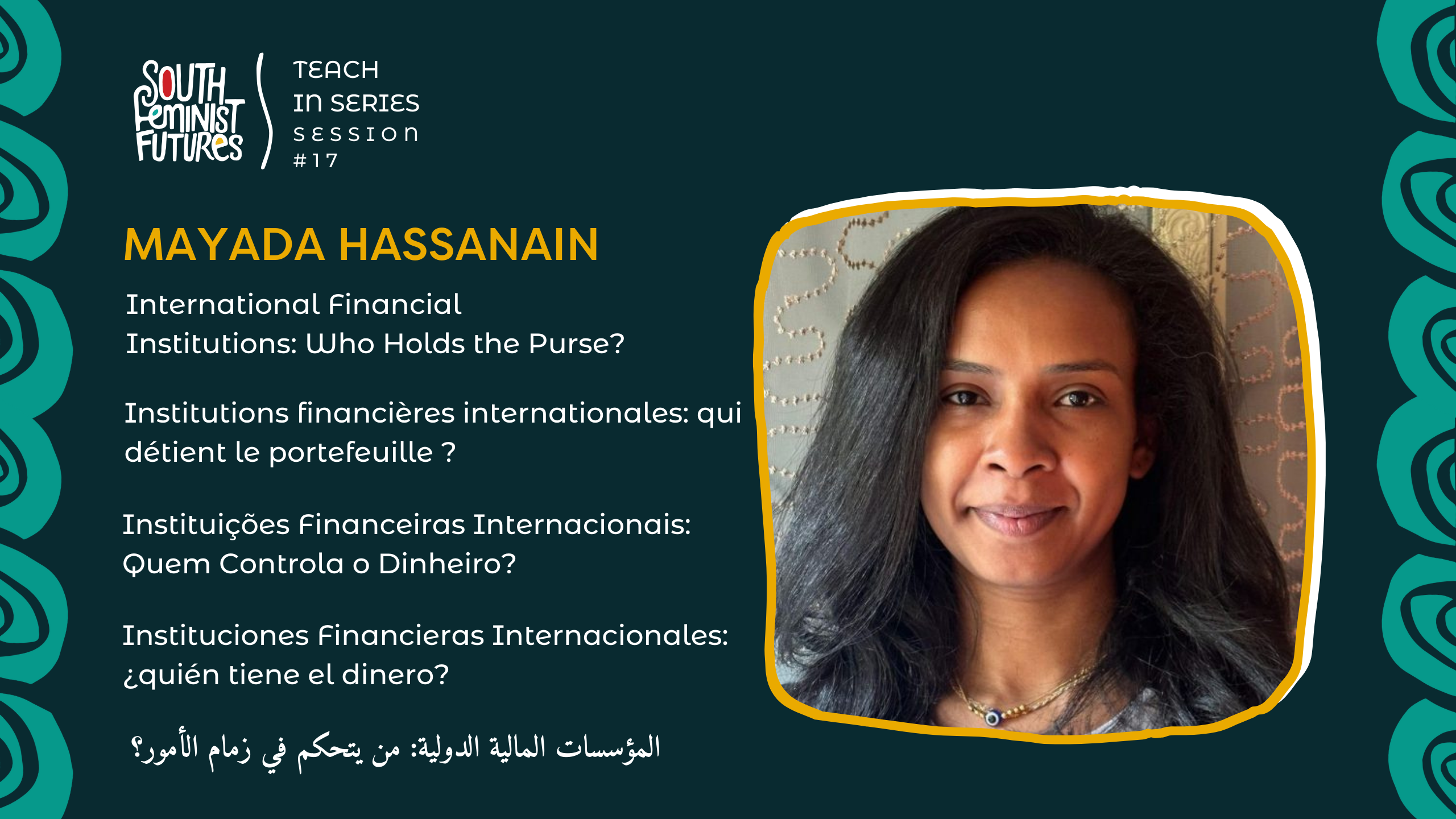
International Financial Institutions: Who Holds the Purse?
In this talk, Mayada provides a critical overview of the International Financial Architecture (IFA) and its two central institutions, the IMF and the World Bank, arguing that these bodies, far from being neutral arbiters of global economic stability, were designed to advance specific economic and ideological interests, particularly those of the United States and other wealthy nations. She traces how both institutions emerged from the post-WWII Bretton Woods system and became vehicles for embedding neoliberal structural adjustment into the economies of the Global South. Mayada examines how the IMF and World Bank maintain influence through expert reputation, self-serving knowledge production, and geopolitical alliances with authoritarian regimes, and how, despite a stated shift in discourse, the same damaging policies persist under new framing. She also critiques how IFIs have incorporated gender and women’s rights into their agenda, arguing this represents an appropriation of feminist goals that ultimately serves market expansion rather than structural change. She concludes by calling for a politicised critique of neoliberal orthodoxy and radical alternatives to conditional debt dependency.
The International Financial Architecture (IFA) & International Financial Institutions (IFIs)
Mayada begins her talk by introducing the IFA—”a framework of institutions, policies, rules, and practices that govern the global financial system”. Its self-proclaimed aim is to ensure global economic stability and development, facilitate international trade and investment, and achieve the United Nations’ Sustainable Development Goals. In her talk, Mayada focuses on two key IFA actors: the International Monetary Fund (IMF), created to promote exchange rate stability and oversee financial flows, and the World Bank (WB), established to provide financial support for post-war reconstruction. Both were born out of the Bretton Woods system, which came into being after the Second World War in an attempt to establish international economic cooperation through a framework of global financial and monetary governance. The creation of these IFIs marked the end of economic nationalism and made national economies subject to the assessment and approval of the global economy – and of the countries holding most power within it. Notably, influence within these institutions is formalised through a voting system that allocates more voting shares to the countries contributing the most capital (the US, as well as Japan, Germany, France, and the UK).
The Power and Influence of the IMF and the WB
Mayada shares three quotes from a 19 U.S. Treasury report that emphasize the role and power of the United States in the IMF and the WB, as well as the neoliberal approach of structural adjustment embedded in their economic and social development policies. Notably, the quotes also explicitly state that these policies were designed to expand economic opportunities for the U.S., substantiating the idea that these institutions are built to advance a certain economic agenda.
One way the IMF and WB maintain power is through their supposed “expert reputation”: the perceived expertise of those heading these institutions allows them to unquestionably influence the socialization and training of officials from developing countries. They mobilize local leaders to act as spokespersons for them, forcing Global South populations to confront structural adjustment imposed by their own governments. This serves as a lifeline for IFIs, helping them endure despite their terrible track record: they have not only failed to achieve economic growth but have actively caused regression. IFIs’ power becomes even stronger when they support violent dictatorial regimes, especially against the backdrop of the Cold War, when the U.S. was seeking both economic and ideological allies.
The IMF and WB also maintain power through their research, which is widely read and cited despite not being peer-reviewed and rarely challenging the institutions’ policies even when data and analyses expose gaps or failures. As such, Mayada argues that these publications are a “self-serving knowledge-production entity”, where knowledge creation is presented as neutral and expert, but is, in fact, partial and selective. This, alongside other selective practices, shuts down any space for dissonant discourse within these institutions.
IFIs and Neoliberalism
The rise of neoliberalism in the 1980s led to policy shifts that caused further destabilization in the Global South. Amid the rise of conservative governments and the debt crisis of the 1970s, both the IMF and the World Bank adopted conditionality — meaning that loans and financial support became tied to a set of neoliberal policy recommendations centered on liberalization, privatization, and deregulation. In the Global South, this not only constrained policy space but also weakened decolonial aspirations for sovereignty, highlighting how structural adjustment sought to reconfigure not only the economy but society as a whole.
Mayada discusses the critiques and failures of this approach, citing three examples of its negative impact:
- increased spending on debt servicing;
- depletion and overuse of resources, with profits overwhelmingly benefiting foreign companies; and
- deterioration in the quality of life.
In response to this, IFIs shifted their discourse to acknowledge the importance of social security, protection, development, and support for those who may be negatively impacted by the transition to a market economy. They even abandoned the term “structural adjustment”. However, the approach itself persists under a more mystified, favourable narrative, and Global South countries remain trapped in cycles of debt and loans. IFIs continued to frame privatization and the liberalization of the market as neutral, objective economic truths, and the more this became normalised, the more they foreclosed the possibility of developing alternative economic tools.
Mayada illustrates how neoliberalism deepens the effects of crises by examining the Covid-19 pandemic and the Sudanese revolution. She explains that countries already burdened by decades of structural adjustment suffer more severely during these events. Through graphs, she shows that many Global South countries owe up to 80% of their debt to the WB, with debt servicing costs reaching up to 20% of national revenue. This reveals a self-perpetuating cycle in which the same neoliberal policies that create debt are reapplied to manage it.
IFIs and Women
IFIs began mentioning women in their policies in 1982—during the United Nations Decade for Women—and only in two contexts in the Global South: as peasant women or as “backward women with too many children”. Both of these racialized notions implied that women were not struggling economically or socially because of structural adjustment, but rather that their roles as peasants or caretakers were unproductive for the economy, and that gender equality would be achieved if these women were integrated into the labour market. Mayada argues that this framework dismisses a proper analysis of gender under existing economic structures and ignores social reproduction and gendered care work as uncommodified labour.
In 2007, the World Bank rolled out its Gender Action Plan, titled “Gender Equality as Smart Economics”, which made a business case for gender equality. It implemented new policies, such as cash transfer programmes and microfinancing for women in an attempt to make women “more productive” and achieve poverty reduction. In 2022, the IMF also released a gender strategy, with main tenets centred around “good governance”, including ending gender-based violence, engaging women as leaders, and expanding equal access to economic opportunities, participation, and assets—in brief, policies focused on how women can and should be integrated into the market economy.
Mayada critiques this approach as an appropriation of feminist ideas of gender equality that originally advocated for structural change, rebranding equality as something that is economically efficient. This strategy frames women as rational economic actors whose ultimate purpose is to drive economic growth, discursively humanizing policy recommendations through gender markers but without producing any meaningful change.
Mayada also notes that this form of liberal feminism primarily services wealthy women. First, women living in poverty are pushed into the market economy not out of empowerment but because selling their labour power becomes a matter of sustenance. Second, while more women are absorbed into the market, the state continues to retreat from providing public services, meaning that care work is very much still needed from those who cannot afford private services.
To conclude, Mayada argues that, at its core, feminists stand against IFIs because their conceptualization of women and the economy is inaccurate—from where women are positioned in the economic structure to how progress is measured—and that the IFA continues to promote growth based on the exploitation of labour and resources from the Global South.
This highlights the need for a politicized critique of neoliberal orthodoxy and a search for real alternatives. In the Q&A, Mayada reframes a question on sovereignty in development financing, asking why we remain dependent on conditional loans and how we might free resources to self-finance. She proposes a radical move toward collective default as a way to shift power dynamics and leverage existing strength against an unjust economic system.
Summary by: Talah Hassan
Liked this article? Share it!


