
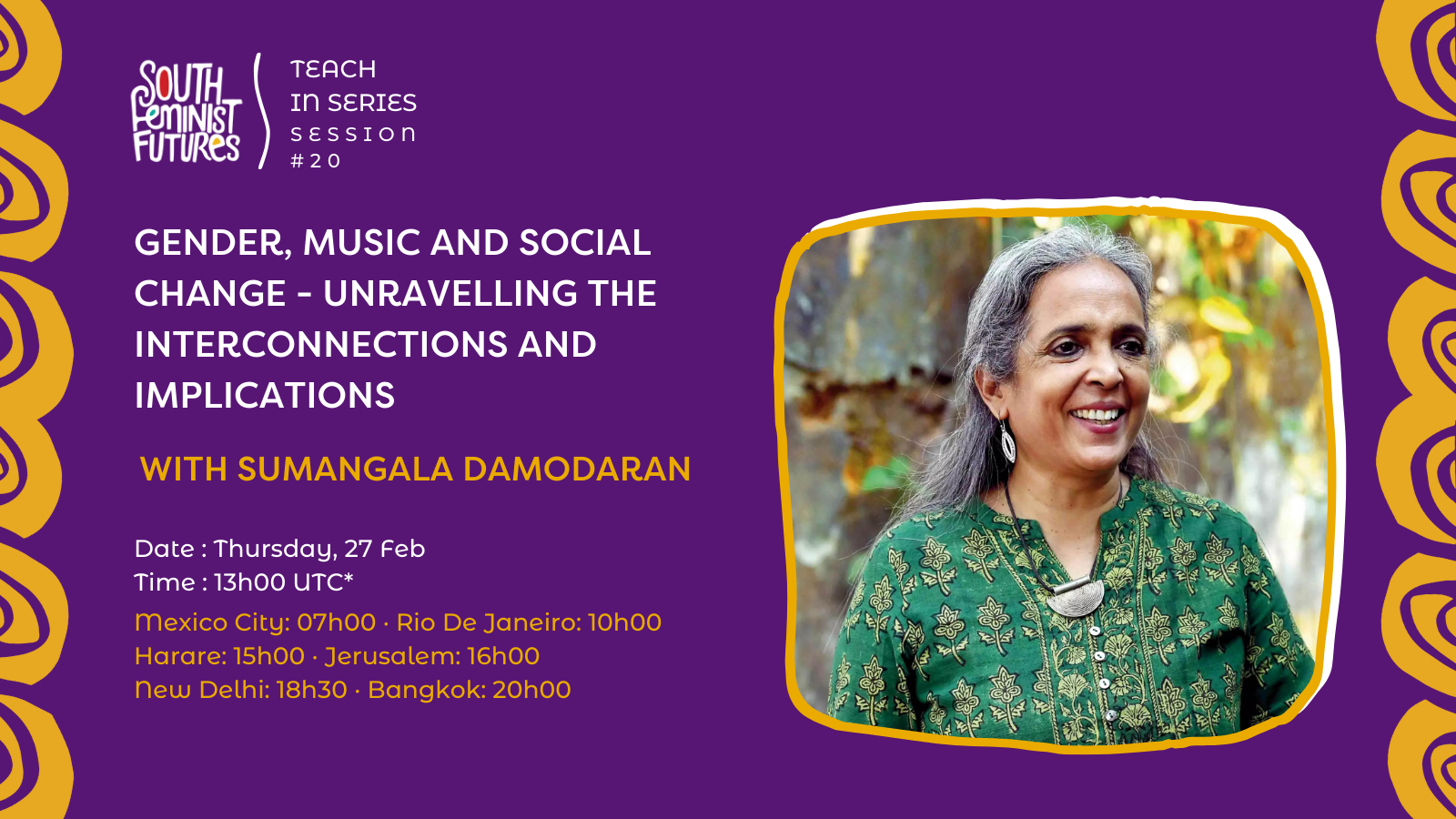
Introduction: Music, gender, and power
This teach-in by Sumangala Damodaran explores the deep interconnections between gender, music, and systems of social power, examining how musical forms both reflect and reproduce hierarchies of gender, race, caste, and class. Drawing from her work as a scholar, activist, and performer, she asks how music encodes social relations – and how it can also become a site of resistance and transformation.
Two key questions guide this teach-in:
- (How) does music, in its many forms, reflect social stratification, hierarchies, and identity?
- Is there a difference between more and less codified systems of music—Western/non-Western, superior/inferior—and do these classifications influence how society and its stratifications are reflected in musical forms?
Music as a social mirror
In answer to these questions, Sumangala specifically considers the relationship between gender and music, and how they reflect and reveal each other. To explore this, we can look at representation – such as how many women and genderfluid people we see in music, as performers or as audiences – but we can also delve deeper to understand the messages and codes that music conveys about social relations and dynamics and how these codes get ascribed. Music operates as a system of signs, conveying ideas about hierarchy, identity, and belonging.
The associations one makes with a particular musical form, and how this form connects to the audience, is one way of reading these dynamics. This includes how certain musical forms are considered superior, more serious, “higher’, while others are viewed as inferior, unserious, “lower”, or whether a form is written down or transmitted orally. It also includes the levels of familiarity one has with a particular type of music—who is familiar with it, what that familiarity is based on, and how an unfamiliar listener perceives and responds to a new musical form?
Music communities: production, listening, dissemination
From here, we can identify the different communities that exist around music: the producing, the listening, and the dissemination communities. Sumangala explains that understanding these communities helps reveal how the world of sound is formed and transformed. They give us insight into how a particular musical form is codified and what boundaries exist around it (e.g., criteria for classifying it), but also how those boundaries are crossed in ways that allow new forms and new audiences to emerge—something shaped by the listening and dissemination communities, who play a crucial role in how music develops and changes.
Codification, hierarchies, and power
Sumangala argues that this process—understanding the codes and the communities within the music—takes place within a broader context of power relations. She introduces the idea of codification: the process through which musical traditions are formalised into systems of rules governing performance, transmission, and legitimacy.
The idea of superiority and inferiority, for instance, is deeply coded by racialised patriarchal capitalism: Western music has fashioned itself as “rational music”, and its men are the ones who have become famous. Women, on the other hand, are deemed inferior in creativity and skill, and thus deemed as rationally incapable of achieving what men achieve – even though women and genderfluid people have always been at the centre of many musical traditions across the world.
Similarly, non-Western music, often the music of former colonies, has been contrasted with, and therefore looked down upon by its “rational” Western counterpart. Western music has historically positioned itself as “rational” and superior, while non-Western traditions are cast as inferior, reflecting colonial logics of knowledge and value.
So, just as gender is an important marker in the relationship between music and politics, Sumangala demonstrates how hierarchies of race, caste, class, and other social stratifications assign inferiority to those deemed “Other”, particularly within the contexts of colonial relations and global histories of slavery and subjugation.
Gender, erasure, and music histories
To highlight these dynamics, Sumangala gives examples of historical musical traditions carried forward by women slave musicians, historically gender-nonconforming performers (referred to in colonial records as “effeminates”), and courtesans in West and South Asia. However, these histories are often erased, and the formalization and codification of this music—meaning all the “rules” around production, performance, transmission, dissemination, as well as voice, familiarity, and response—have largely been carried out by men of higher status. Power dynamics manifest once again in the codification of the music itself, which renders “unruly” people as inferior, erasing their role and their identities, even as their musical contributions are retained. Those who create musical traditions are often excluded from defining them.
In the contemporary period, women continue to be marginalised in the musical traditions that they were once central to. Sumangala gives three notable examples in which women are key producers and participants: Rai music from Algeria, Thumri music from India, Pakistan, and Bangladesh, and Mande music from West Africa. In all three traditions, the topics sung about are deemed taboo—be it because they are risqué, rebellious, or revolutionary. Because of this, Rai was at first banned and then eventually commodified and appropriated; Thumri lyrics and performances were sanitized; and men in Mande music came to be viewed as more superior and serious than women, granted greater freedom to “stray from the canon” of the musical form. Ultimately, this all reflects how men who take over certain musical traditions are given more legitimacy in codifying, preserving, and transforming them.
Music, resistance and social change
To conclude her talk, Sumangala shares examples of contemporary, women-led music emerging from highly politicised contexts, such as Black Lives Matter, the Mexican movement against femicide, or the Woman, Life, Freedom movement of Iran. In the Q&A, she notes that one key element of mobilising social change through music is ensuring that it is participatory and collective. She also contrasts this with how subversive music can be commodified and sanitized, and even weaponized against subversive movements by framing it as something that can bring peace or unity without resolution. She also gives the example of how music can be mobilized to control society, such as the example of nationalist movements’ music or national anthems. Overall, the examples throughout her talk and the Q&A illustrate that music both reflects social relations and serves as a lens for social change, uncovering the codes embedded in the histories, structures, contexts, communities, and performances that shape a particular musical form or tradition.
Summary by: Talah Hassan
Liked this article? Share it!


