
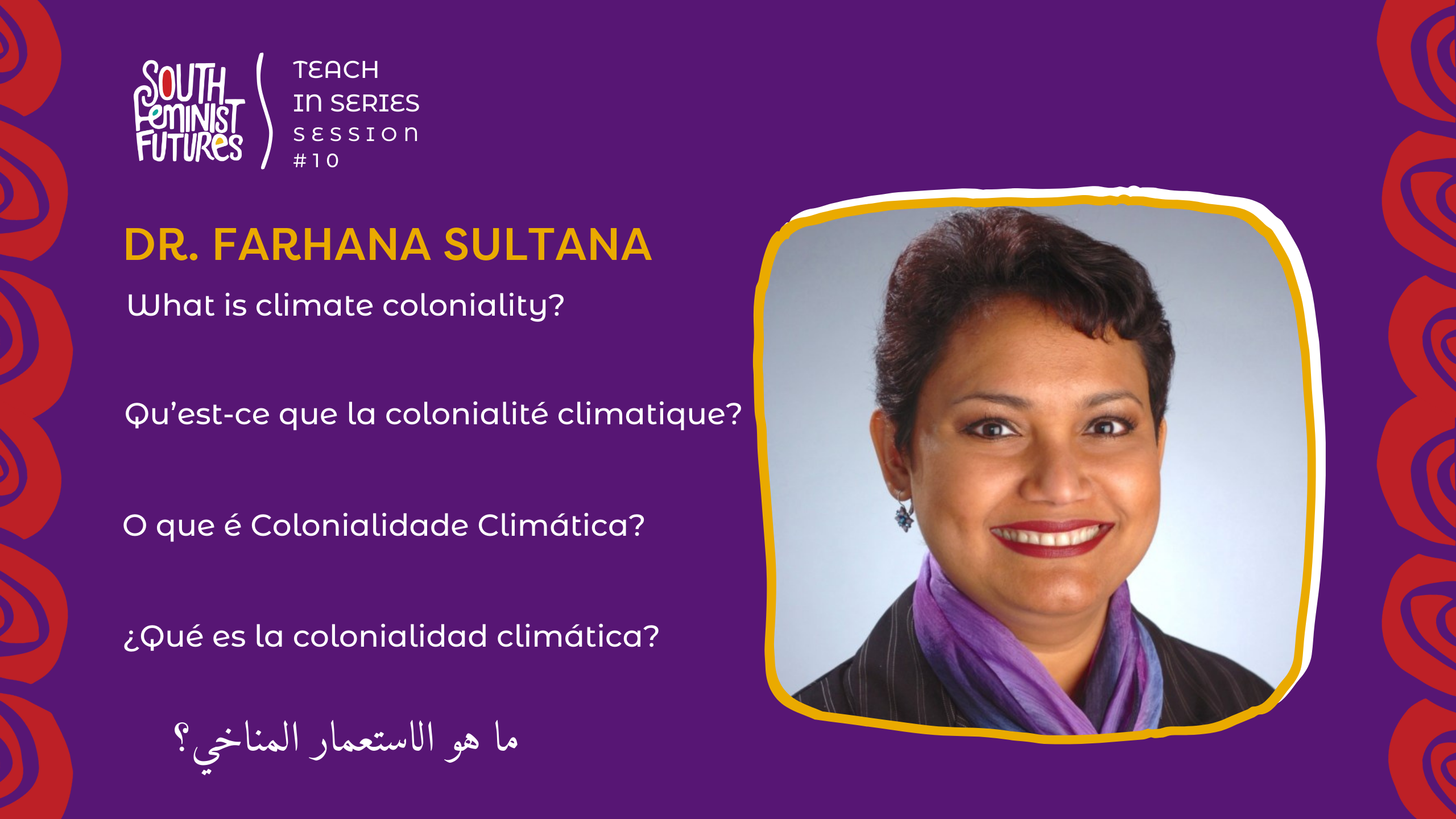
Climate change as climate coloniality
In her talk, Farhana Sultana examines climate change and climate disaster through the intertwined lenses of colonialism, imperialism, racial capitalism, and heteropatriarchy. These are systems that form a Eurocentric matrix of power on geographical, political, and onto-epistemological levels – in other words, in both policy and ideology, where action and discourse around climate change reproduce colonial power. This matrix perpetuates an unequal ecological exchange between the Global North and the Global South, where Western domination allows for over-development in the Global North through the extraction and commodification of resources from, and therefore at the expense of, the Global South. Farhana is sure to note, however, that local elites in Global South contexts are often complicit in the co-production of the very systems of domination that harm their own populations.
By politicising climate change in this way, rather than understanding it as a simplistic, apolitical environmental concern, she is pushing to confront and dismantle the long history of systemic oppression and racial domination that has led us to this urgent state of ecological degradation. This is what makes up climate coloniality, a term that implies colonial continuity perpetuated through climate change, and embodied in the lived experiences of those existing in post-colonial space/time. Farhana specifies tropical and subtropical areas as being particularly affected by climate crises, which impacts racialised populations who are made vulnerable by colonial domination, both in their homelands and in contexts of climate migration. Such dispossession is a disruption of agency and the possibility of self-determined futurities.
Throughout her analysis, Farhana names the process that in practice upholds these dynamics: institutional coloniality, which is the post-colonial afterlife of the empire’s active colonisation, maintained through modernity, international development, policy-making, knowledge production, and uneven global economies, trade, and consumption. The institutions and states that hold power over these processes globally are centralised in the Global North, and this power is self-reproducing: their programmes, policies, and discourse are at the core of climate change, but they are also responsible for proposing and implementing solutions for the very problems they’ve created.
Climate “solutions” might look like land and water grabs, deforestation, neoliberal conservation projects, fossil fuel warfare, green new revolutions for agriculture and GMOs, rare earth mineral mining, or carbon offsetting programs. While these interventions may be framed positively in the name of development, they result in domination, degradation, displacement, and impoverishment—which represents what Farhana calls “geopolitical climate necropolitics”. This itself is a term that implies the socio-spatial differentiation between North and South, designating the disproportionality of who experiences abjection, precarity, and trauma, and is therefore deemed disposable, as a result of climate breakdown.
Cognitive coloniality and epistemic violence
In parallel to the material processes of climate coloniality, Farhana describes cognitive coloniality: the colonisation of the mind about what is knowable and what has value. This is a form of epistemic violence, which manifests as the Eurocentric hegemony of knowledge production around climate change, subsequently limiting the terms of global discourse and therefore the possibility of alternative epistemologies for climate change repair. Non-Hegemonic knowledge production values feminist, anti-colonial, decolonial, anti-capitalist, and anti-racist analyses, which Farhana argues are critical approaches in addressing and undoing internalised race science and ongoing oppression, and working towards cognitive justice and epistemic decolonisation. On a conceptual level, this process involves challenging the conformity and uniformity of capitalism, acknowledging the shrinking spaces of alternative discourse and action, and inviting plurality and place-based knowledge in our approach. Citing Fanon and bell hooks, she also argues that it involves acknowledging how colonialism is enacted on land, bodies, and psyches, built on racial and classed differences, and dismantling this to move towards self-realisation and healing through care and mutuality. As such, in order to decolonise climate justice and attain distributive justice, reparations, and restitution, both material/political practices, and discursive/epistemic ones are necessary.
Material/political: this involves structural changes in international governance towards shared governance, accountability, equity, and distributive justice—a process that is resisted by the current global governance network because it threatens power and wealth. Actionably, structural change towards climate reparations could mean debt cancellation in the face of an extractive neoliberal global trade system. It also means reconfiguring relationships across geopolitical scales, and between humans and nature as part of one ecosystem. This includes, among other things, valuing indigenous knowledge and learning from indigenous work in settler-colonial contexts, as well as building solidarities across frontlines.
Discursive/epistemological: Farhana argues that those dominating climate conversations are generally white men in the Global North—in other words, not those experiencing climate devastation and those who have local knowledge. Shifting away from this whitewashing means shifting who holds the expertise—who sets the agenda, who is heard, who determines the terms of discourse, and who has decision-making power. She vouches for pluriversal (non-universal), non-Eurocentric, non-masculinist, and non-capitalist understandings of nature-society relationships that foster conviviality. This should take place in the classroom, and across institutions and organisations that have internalised Westernised education. This can lead us to imagine futures that are not haunted by colonial pasts and presents—and she specifies as well that decolonial futurity is not a return to pre-colonial times, but rather a strive for something new and better.
Care-full climate revolutions and decolonial action
Building on her point about care and mutuality, a core element of a feminist approach to decolonisation, Farhana uses the term care-full to urge us towards resistance movements that are full of care. She argues that solidarity is about building with others, and that care work is what sustains revolutions. As such, we should foster care networks that encompass human and nature relationships, which makes space for accountability, reciprocity, mutual responsibility, and ethical processes.
Drawing on this feminist, collective ethics of care, she gives several practical examples of what decolonisation can look like: it could be direct action, legal reform, forging alliances, cultural resurgence practices, blockades, land back movements, using native languages, fostering collective memory, cultural rebuilding, story-telling, or building counter-narratives and counter-mapping. When this praxis holds care at the centre, decoloniality also becomes about a reaffirmation of humanity, an assertion of agency, practices of safety, and the possibility of healing colonial wounds through transgressive love. This kind of praxis requires reflexivity around what it means to be in community, especially as transformation can be iterative, non-linear, and must be continuously reassessed—as Farhana puts it, “we need to recuperate a recognition of co-produced emergence and its impermanence. It is a becoming and not an ending”.
To mobilise such praxis, Farhana says that there must be collaborations between academics, activists, and communities—this is a strong ground for advancing new agendas and knowledges in existing global systems. This, however, also calls on us to be cautious. While alternative knowledge-making is essential, research can be a form of theft and extraction, whether it’s “parachute researchers” who pop in and out of local communities for their own gains, or corporations and policy makers who adopt research for their own agendas. She reiterates therefore that the education system is an essential place to start—the classroom is a site of political revolution, and researchers need to be retrained to understand the responsibility they hold. As Farhana concludes, politicising and challenging coloniality “is entirely about intimate, material, and geopolitical connections to other people and ecologies we’re connected to”.
Summary by: Talah Hassan
Liked this article? Share it!


