
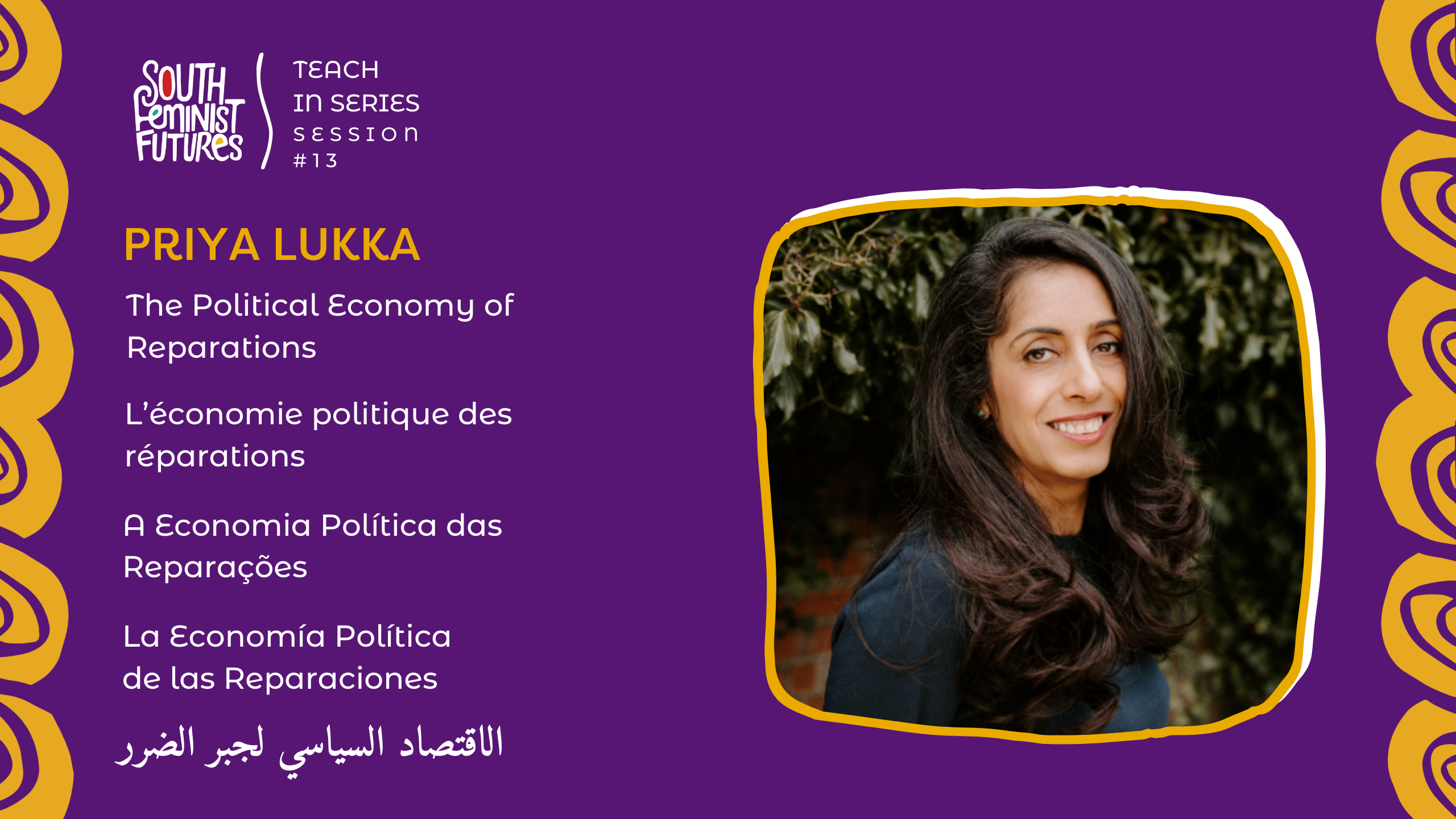
The Political Economy of Reparations
‘The Political Economy of Reparations’ is the thirteenth session in South Feminist Futures’ (SFF) Political Education series. It was held on June 6, 2024, and taught by Priya Lukka, an economist in international development. Lukka is currently a PhD candidate exploring approaches to repair and reparations towards alternatives to economic colonialism at the University of Leeds, UK. Lukka’s talk for the Teach-In was based on her extensive research and reflection on the specificity and intricacy of diverse reparations processes concerned with colonisation, slavery, and civil war around the world.
In this teach-in, Priya Lukka explained that, broadly conceived, reparations is a way of thinking about remedy for harm that has been caused, within a decolonial economic vision of a world where access to power is unequal. Numerous movements, campaigns, knowledges, policies, programs, and principles fall within the concept, ranging from truth commissions following mass human rights abuse, studies that quantify damages, government consultations, and a general tenet of global solidarity.
Importantly, calls for and calculations of reparations can constitute a re-telling of world history away from Western colonial frameworks of posing problems and solutions currently dominant, such as neoclassical economics approaches to poverty and current multilateralism. Indeed, when a reparations process is undertaken according to Western norms of human rights and justice, it can simply reinforce historical exclusion at the local level, among other problems caused by ignoring cultural specificity. The Truth and Reconciliation Commission established by the government of Nepal after the civil war between the Kingdom and Maoist rebels, for example, failed to account for the past and present exclusion on the basis of caste that was essential to a genuine process of transitional justice.
Reparations, as Lukka taught, is not a new or recent concept. Calls for reparations for slavery were part of the Sons of Africa movement in the UK in the 18th century. They take in the 20th-century Pan-African movement and 1960s movements for Black self-determination in the US, and are found in present-day global responses to the murder by police of George Floyd in the US and in burgeoning movements for climate justice and Land Back to Indigenous peoples.
Moving to the present day, Lukka discussed current policy and campaign activities such as the Dutch government’s December 2022 apology for slavery, which opened a legal basis for reparations claims to be progressed through legal measures, and regional processes such as the recent statement by CARICOM, the regional body for Caribbean nations, to make 2025 a joint year of campaigning for reparations. Lukka also noted that the Loss and Damage Fund established by the UN Framework Convention on Climate Change in 2021 was set up using principles of reparation introduced by Bolivia into this dialogue in 2009.
Before this history and present of movements and actions for reparations, important questions arise, such as: why have reparations been paid in some contexts but not others? Why, for example, did Germany pay reparations to Holocaust survivors as recompense for their suffering under the Nazi government, while Haiti was required to pay reparations to France following Haiti’s independence and abolition of slavery? In a similar vein, Lukka showed how, throughout the life of demands for reparations, tensions arise around the demands for compensation from systems that continue to create harm, and often the very same harms of racist policy and organised exclusion.
For Lukka, the question of ‘what remedy is needed?’ for harms such as those of colonisation and slavery is a question that all must be engaged in answering, not just academics and/or policy-makers. It needs to be a whole-of-community, community-owned process that must ensure the most marginalised community members have full access.
A rich Q&A session followed Lukka’s talk. Questions from participants included how reparations might address both internal and external processes of colonisation, such as in Abya Yala/Latin America; how the demands of Indigenous feminism are/could be operationalised in reparations; and the role of companies that were part of colonial projects, such as Barclays Bank in the US, in making present-day reparations. In response, Lukka shared information and reflections on money policy sovereignty, such as the dependence on the French franc in former colonies of France; the potential alliances and distinctions between philanthropy, surveillance, and reparations; how INGOs might engage in calls for and responses to reparations; and the problem of applying neoliberal policy principles to reparations agendas.
Summary by: Ann Deslandes
Liked this article? Share it!


