
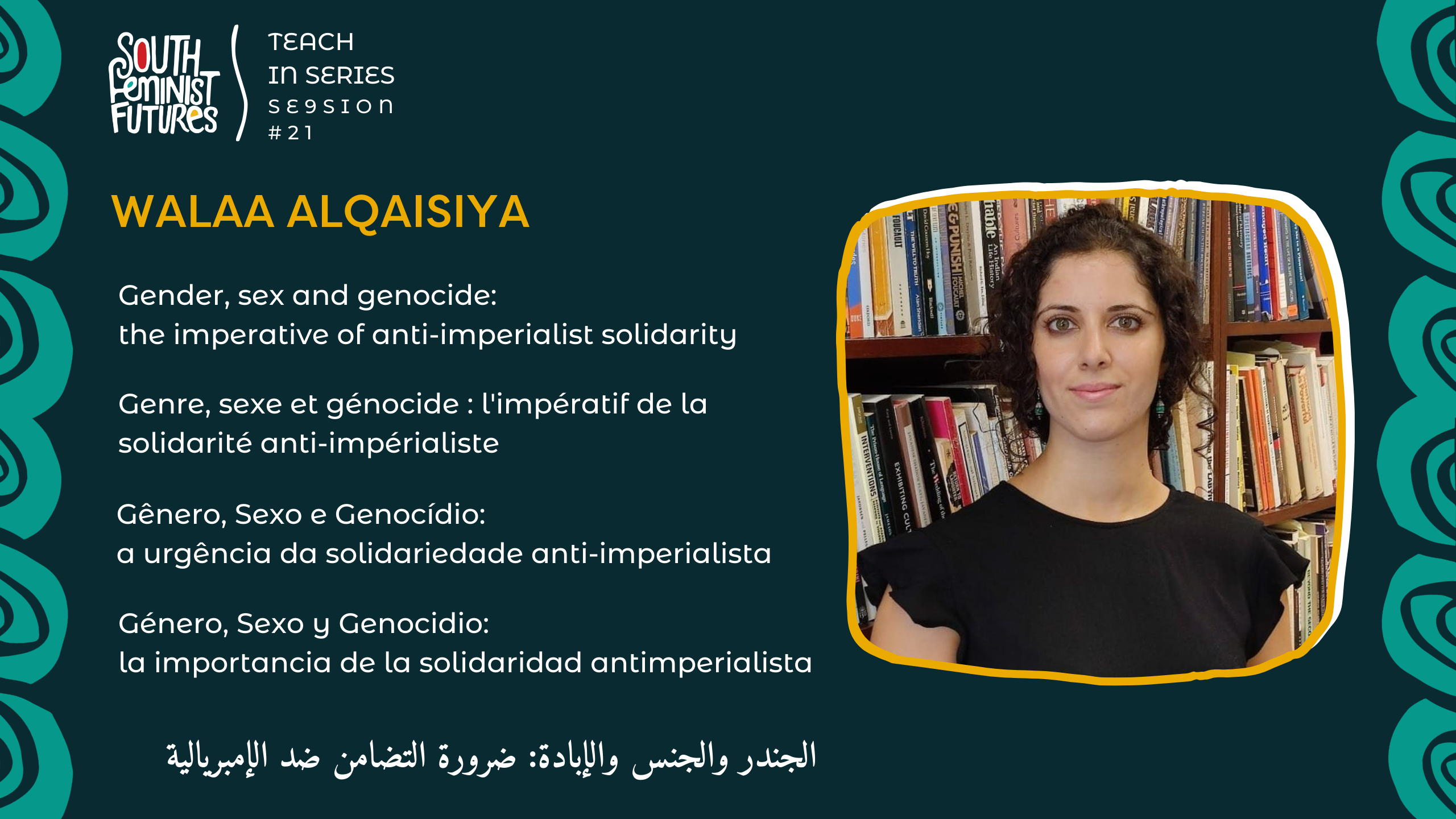
Gender, sex and genocide: the imperative of anti-imperialist solidarity
In this talk, Dr. Walaa Alqaisiya offers a critical analysis of how gender and sexuality are weaponised by Israeli occupation and its Western allies to justify the genocide in Gaza. She argues that the colonial logic of “saving” Muslim women and queer people from Arab barbarism — known as pinkwashing — has long served imperial powers and continues to do so today, functioning as ideological cover for dispossession and massacre. Situating this within the colonial/modern gender system, Dr. Walaa connects the politics of gender recognition to capitalist-imperial accumulation, arguing that the figure of the “emancipated Arab woman” is not liberatory but incorporative — a tool of domination. She further develops the concept of ungendering, showing how the dehumanisation of Palestinians reduces them to bare flesh, stripping them of gendered or sexed identity to designate them as legitimate targets for elimination — a process that is both ideological and materially embedded in the economy of waste. Against these logics, Dr. Walaa advances an anti-imperialist, decolonial queer feminist framework that rejects single-issue politics, centres collective struggle and the right to resistance, and positions Palestinian liberation as inseparable from broader global struggles against poverty, war, and imperialism.
The Gendered/Sexed Logics of Genocide
Dr. Walaa begins her talk by outlining the ways in which gender and sexuality are weaponised by Israeli occupation and its Western allies to justify the genocide in Gaza – and more broadly, the existence of the Zionist entity in the region. They do so by scripting women, girls, and queer people as victims of Arab barbarism in general, and of Hamas’ male savagery in particular, playing into the colonial trope that “civilised” white men must save helpless Muslim women and queers from sexist, homophobic, terrorist Muslim men—a logic known as pinkwashing.
This discursive process has long been adopted by imperial powers. For example, Israeli officials claim that the current war is being waged “to save the values of Western civilisation” and that “the Hamas rapist machine bears full responsibility” for the ongoing genocide. Zionists circulate images of Israeli soldiers with the pride flag amidst destruction in Gaza, while official international bodies such as the UN have condemned “the sexual violence committed by Hamas” on October 7—even though a UN investigative report itself admitted that it was unable to verify any of these claims. Importantly, pinkwashing has also served what Dr. Walaa calls the “Hillary Clinton imperialist feminist cult”—imperialists who weaponise feminist discourse to justify genocide for their own interests in the name of “emancipating women”. As such, Israel’s presence in the region is portrayed as serving a benevolent and protective duty towards women and LGBTQ+ people by imperialist men and women alike, thereby justifying and enabling the ongoing dispossession, siege, and massacre of the Palestinian people—including, of course, the lives of women, queers, and children.
The Colonial/Modern Gender System & Racialised/Sexualised Dehumanisation
Dr. Walaa argues that the logic of this colonial/modern gender system must be historicised so that we can understand its foundations, its workings, and its apparent contradictions; the same Zionist war machine that claims to champion women’s and queer rights deploys this moral argument to justify its indiscriminate genocide against all Palestinians.. She situates the logic of this gender system within the intersection of capitalism and colonialism, which constructs the white bourgeois man as morally superior and the epitome of liberal values and freedom. Bringing in a material analysis, Dr. Walaa argues that gender and the politics of recognition are weaponized to serve imperial capitalist accumulation. Rather than being liberatory, the notion of “emancipated [Arab] woman” works to incorporate gender into these systems of domination.
Dr. Walaa elaborates on the constructed distinction between coloniser and colonised, where racialised binaries continue to justify colonial violence through a process of dehumanisation: the human versus the animal, the garden versus the jungle. The human coloniser—the bourgeois white man—has restraint and reason, whereas the colonised “animal” is amoral and savage. In the context of Palestine, the colonised is a “terrorist sub-species”; October 7 is marked as the moment of “absolute beastliness”; Gaza is framed as the realm of the jungle; and Israel presents itself as the “force of light” at war with “forces of darkness”.
Colonised women are not spared from these constructions—they are often hypersexualised and depicted as beastly. During the ongoing war, videos of soldiers rummaging through women’s lingerie and calling Arab women “whores” and “sluts” were widely circulated. Zionists and their backers, including feminists, are constantly reproducing these categories to enable the continuity of the genocide, a process Dr. Walaa refers to as “the occupation of gender”.
The Economy of Waste and Ungendering
Dr. Walaa explains that this dehumanisation is not only ideological but also materially and historically embedded within the capitalist-imperial relations of the region. Israel, as a Zionist settler colony, functions as an outpost for US hegemony in the Global South, reinforcing the North/South boundaries that delineate sites of extraction (the South) and those of accumulation (the North).
Drawing on Ali Kadri’s work on the economy of waste, she argues that death under imperialism in the Arab region enables accumulation by waste, where waste and death are intrinsic to the sphere of production. Death cheapens labour power, shortens labour longevity, and devalues labour. It is not collateral damage but an intentional waste of Arab life that sustains the social reproduction of imperialism through its settler outpost. The genocide exposes this process – ideologically through the propagation of liberal values, and materially through military and economic investment and consolidation via death.
Deconstructing this logic and returning to the occupation of gender, Dr. Walaa reveals how dehumanisation and death in fact enact a process of ungendering—the ideological and material reduction of Palestinians to the site of the flesh, vacant of any gendered or sexed signifiers. As such, she reiterates how gender and sexuality are merely weaponised as a logic that serves imperialism, rather than in service of any form of emancipation.
Indeed, these two arguments define the two levels of the ungendering process:
- The casting of the racialised Other as a terrorist sub-species outside humanity – and by extension outside of gender and sex – designating all Palestinians as legitimate killing targets and making this logic central accumulation by waste; and
- The symbiotic relationship that ungendering necessarily maintains with pinkwashing and modern gendered scripts themselves, which together sustain the structures of imperial colonialism and capitalism. Here, the racialised Other moves between being an “undifferentiated terrorist” and a victim with a sexed or gendered identity, according to what Dr. Walaa calls “the shifting calibrations of western bourgeois ideology”— or what U.S. hegemony needs in any given moment for its imperial strategy.
Anti-imperialist Queer Feminism
To challenge the occupation of gender discursively and by praxis, Dr. Walaa advances an anti-imperialist, decolonial, queer feminist approach to liberation. This framework rejects single-issue struggles focused solely on gender or sexuality and instead calls for historicising gender and queerness as integral to decolonisation. Queer liberation, in this view, is tied to Palestinian liberation, as seen in queer anti-imperialist mobilisations that call for boycott and uprising, demand dignity over depoliticised gay “pride”, and resist the violence of pinkwashing by recentering collective struggle over individualism.
For Dr. Walaa, this framework exposes the shortcomings of existing anti-Zionist feminist critique which, rooted in post-structural abstraction, often reproduces the very liberal logics it seeks to resist. Such approaches tend to isolate queer identity from class and structural analysis, dilute the national Palestinian question, and promote coexistence narratives between Palestinians and Zionists that obscure systems of domination and the U.S. imperial interests. She specifically critiques Judith Butler, who beyond holding the stances described above also brought in a moralising element to their reading of October 7. Butler’s moralising emphasis on non-violence after October 7 condemned Hamas and proposed coexistence while ignoring Zionism’s colonial function.
In contrast, the anti-imperialist queer feminist praxis that Dr. Walaa proposes centres the right to resistance and struggle by all means necessary, citing revolutionaries George Habash and Leila Khaled as examples. She specifically cites Khaled’s claim that “indigenous counterviolence is a site of inventiveness of the colonised flesh” in the face of discursive “colonised nonbeing”, a “defiance rising out of abjection”. In closing, she reiterates Khaled’s assertion that Palestine in fact enfolds global fights against poverty, war, and imperialism. She reflects on the fact that on the legal and political front, it is other Global South countries fighting for Palestine, adding in the Q&A that global alliances with other movements are needed to form a wider struggle for liberation. She finally affirms that Palestine can encourage, if not ignite, a global uprising that could change the world.
Summary by: Talah Hassan
Liked this article? Share it!


