
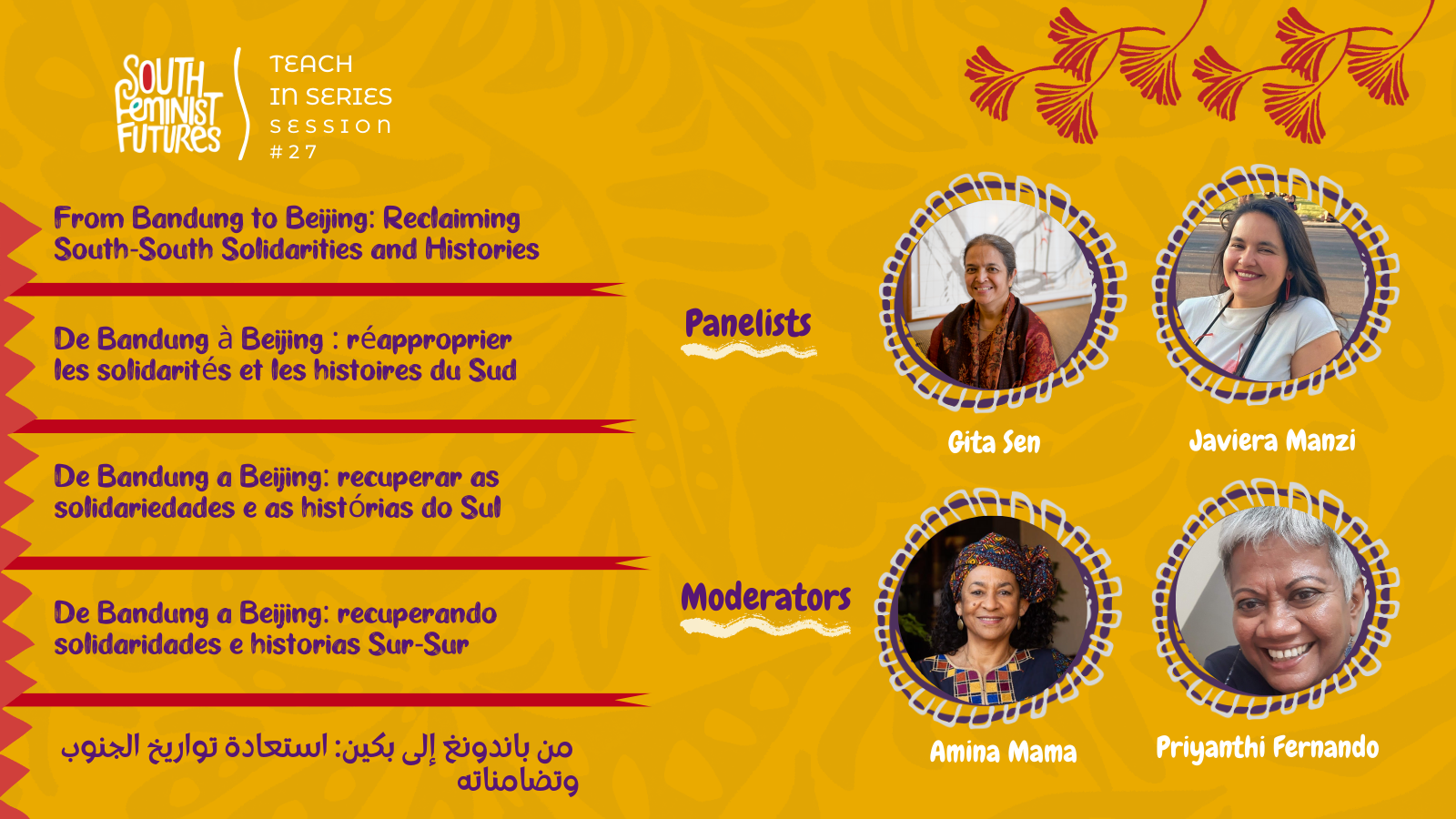
From Bandung to Beijing: Reclaiming South-South Solidarities and Histories
For the thirtieth anniversary of the Beijing Platform for Action Conference, South Feminist Futures (SFF) hosted a panel with Southern feminists to highlight the long, complex and often ignored history of internationalist feminist organizing – a history that preceded, and in its radicality, challenged the UN’s Beijing Declaration. This history of global feminist organizing is often narrated through a lens of liberal, Western frameworks, obscuring far older and deeper traditions of anti-imperialist, socialist, and South-South feminist solidarities. Long before the first UN Women’s Conference and the formal recognition of women’s rights in the 1970s, women across Asia, Africa, Latin America, socialist blocs, and newly-independent countries of the Global South were already forging international alliances grounded in struggles not just against patriarchy, but also against colonialism, exploitation, racial capitalism, and fascism.
With the genocide in Gaza as the backdrop to much of the necessary work and conversations we have been having since 2023, and against today’s conditions of intensified authoritarianism, deepening backlash against gender, sexual and reproductive rights, this panel, titled “From Bandung to Beijing: Reclaiming South-South Solidarities and Histories” highlighted what it might mean, 30 years after Beijing, and 70 years after the 1955 Bandung Conference, to reclaim these histories as living political sources for rebuilding solidarities adequate to the present.
Speaking to the Bandung Spirit through a feminist lens, this panel was anchored by Amina Mama and Priyanthi Fernando and in conversation with Gita Sen (DAWN co-founder and professor) and Javiera Manzi (feminist archivist and sociologist from the Chile 8M movement) – and focused on the roles feminists played, and continue to play, in anti-imperialist and internationalist organizing, beyond institutional recognition.
Bandung to Beijing
The panel began with a reminder of Principle 26 of the 1975 Declaration of Mexico on the Equality of Women on Their Contribution to Development and Peace, which states:
“Women and men together should eliminate colonialism, neo-colonialism, imperialism, foreign domination and occupation, Zionism, apartheid, racial discrimination, the acquisition of land, and maintaining international peace.” A short video followed, showing the stark contrast between 1955’s Bandung Conference’s black-and-white men-only images, and 1995’s Beijing Conference colored women-centered images. Priyanthi then started with the question of why it’s important that we are having this conversation today, when cynics might claim, with some justification, that “we never learn from history”.
A quick overview of Bandung’s Conference and its significance as a convening space for the then-called Third World was provided, focusing on its emphasis to promote goodwill and cooperation between many Asian and African countries while addressing socio-economic issues, questions of sovereignty and nationality, and the problem of imperialism. Most importantly, it led to the establishment of the Non-Aligned Movement(NAM); which provided an ongoing space for South-South cooperation. The “Bandung Spirit” therefore was not merely idealistic – it had a material basis rooted in the freedom struggles of the peoples in the colonized world.
Yet, we see that there were in fact no women visible, despite the significant role that women played in anti-colonial and anti-imperial struggles through three main conferences: Conference of Women in Asia (1949), the Asian-African Women’s Conference (1958), and the Afro-Asian Women’s Conference (1961) which received strong support from NAM. The most important ideas to have emerged from which were two issues: commonality – the recognition that women everywhere experience similar forms of oppression; and non-complicity – that women must not condone or be complicit in acts of global violence carried out in their name.
Then, building on this historical grounding, the panel reflected on how much the world had changed by the time of the Beijing Conference; patriarchal capitalism had expanded further; the Cold War had ended and the collapse of the Soviet Union left socialist states less capable of resisting neoliberalism. Yet, it was also preceded by what was called “The UN Decade for Women”, which led to the rise of many Southern feminist movements, a context that had contributed to the emergence of the DAWN (Development Alternatives with Women for a New Year) network, which took shape at the UN Conference on Women in Nairobi in 1985.
Why was DAWN so significant? And what major contributions did it make to the shifting global landscape?
After introducing DAWN – a network founded in 1985 by a group of women, largely though not exclusively from the Global South – to the participants, Gita identified two enduring internal tensions within the feminist movement that the network had and still has to navigate:
- The problem of liberal feminism: the UN Decade for Women stated the feminist goals of equality, development and peace, yet “equality” was largely understood as a matter between men and women within the household, rather than a matter of structural transformation.This excluded Southern feminists whose realities were shaped by structural adjustment programs, poverty, food and fuel crises, militarization, and rapid expansion of global neoliberal order.
- The question of individual human rights: The Global North dominated discussions on gender equality within the framework of the Universal Declaration of Human Rights that sometimes was willing to address structural inequalities but avoided questions specific to women, such as bodily autonomy, sexual and reproductive rights, violence against women and girls, and patriarchal control over sexuality.
DAWN sought to “walk on both legs”, making sure they make the lived realities of Global South feminists central to their agenda, and integrating sexual and reproductive health and rights (SRHR) within their work on structural inequality. This reverberated with feminists from the South all the way to global forums in Vienna, Cairo, and Beijing.
In the same spirit of emphasizing the role Southern feminists had in pushing the conversations further in Global spaces, Gita Sen recalls the following anecdote: in the drafting of the Universal Declaration of Human Rights, adopted in 1948, the original draft for what became Article 1 used the formulation “All men…”, making the draft read as: All men are born free and equal in dignity and rights. They are endowed with reason and conscience and should act towards one another in a spirit of brotherhood.” Among the 15 members of the UN Commission working on the draft, two women were present: Eleanor Roosevelt, and Indian delegate Hansa Mehta. Mehta objected to the wording as it could be read to exclude women, pushing for more inclusive language, which Roosevelt did not find to be problematic and excused as already meaning both men and women. It is Mehta who pushed, and later led to the revising of the Article so it could begin with “All human beings…”. This was a reminder that women from newly decolonized contexts were not simply present in these processes, but actively shaping what “universal” would mean.
What archival silences surrounded the participation and presence of feminists in Bandung? And what role did such international events play in connecting South-South feminist agendas?
As part of the 8M Movement, Javiera emphasized the ongoing intergenerational feminist efforts in the Global South to reconstruct plural and interconnected histories by accessing both official/institutional archives (like the UN’s) and local records (oral history, letters) which document how women organized, debated, and even prepared for global forums. Drawing on her research on Chilean feminist Olga Poblete, she described early exchanges between women in Latin America and Asia as expressions of transnational solidarity, with Bandung symbolizing the first call for a unified struggle for peace based on justice and anti-imperialism..
Feminist movements in Chile and Latin America had two shared enemies: war and fascism. They linked their activism for peace with struggles for decolonization, self-determination, and economic sovereignty. And while they did not have a considerable presence in meetings like Bandung, the 1975 Women Conference in Mexico was an important space for feminists advocating for human rights for people living under dictatorship. The 1995 Beijing Conference marked a new milestone that pushed Chilean feminists to question what kind of democracy they wanted to rebuild and how to define what it would look like in practice. Concluding her intervention, Javiera noted the importance of the shared task of building a political feminist movement rooted in Southern solidarity and advancing the internationalization of struggles from the South.
How do feminists today respond to the genocide in Gaza and the rise of far-right movements?
Javiera responded by saying that the catastrophic and appalling nature of the ongoing genocide in Gaza compels action. It moves people to demonstrate, protest and organize. In Chile, for example, the experience of the Pinochet dictatorship continues to shape the collective desire for justice and solidarity. It was also important, for Javiera, that we understand new forms of the far right and their mechanisms of gaining power, including persecution and censorship, so we can expand democratic horizons and articulate a feminist agenda.
Gita echoed Javiera’s remarks, and pointed out to the need for a stronger response to the genocide happening in plain sight in Gaza and the West Bank in Palestine, as well as in Sudan – which hasn’t received as much attention, partly because the genocide in Palestine is the most overtly blatant “we will do it” intent of genocide in a long time. The horror has to stop, and that demands a stronger response from feminist movements. “Feminist movements from the South and the North have not raised their voices loudly enough to stop these genocides,” she urged. Then, she connected these crises to broader assaults on the achievements of the Beijing Platform for Action – the rise of anti-gender, anti-queer, and anti-women ideologies across the world. Giving the example of the so-called manosphere, she argued that this phenomenon has its roots in increased globalization and financialization, which has generated enormous inequalities, destroyed livelihoods, and allowed corporate power to run unrestrained. These movements function as deliberate diversionary tactics, scapegoating women, queer people and racialised people who are rightfully asserting their place in the world, so as to divert public attention and scrutiny of corporations and their harms from resource plunder to deep-sea mining and other atrocities.
Similarly to Javiera’s point, Gita emphasized the need to broaden democratic horizons and expand the scope of feminism. Feminism has always included the world and environment that we live and die in, and we should stand against the narrowing tendencies of liberal feminism that remain detached from ecological and material realities while “the world is dying”. She emphasized the need for a strong leadership from the South that links arms with progressive movements – even those that historically marginalize feminist voices – while confronting internal resistance. The need to link anti-patriarchal struggles and development justice is more explicit than ever, as we have learned from recent crises, most notably Covid-19 and the mismanagement of health access facilitated by Intellectual Property rights, underfunded Public health sectors due to years of structural readjustment policies and austerity, and structural inequalities along lines of race, class and gender.
How can the Bandung Spirit operate in the context of genocide, rising global fascism, and multiple crises? What does it mean to reclaim the Bandung Spirit of internationalist South-South solidarity in our time?
Priyanthi reflected on the idea that, despite political differences, the participants of the 1955 conference shared the common goal of fighting colonialism. This is the essence of that Bandung spirit – to not be complicit in the atrocities taking place in the world.
For Javiera, reclaiming this spirit hinges on bringing back the idea of universality from the Third World and the revolutionary concept of peace. “We need to organize for peace,” she said, “but a peace that is connected to self-determination, decolonization, and self-sufficiency.”
Gita expanded on this, recalling the collective conviction of Bandung that colonialism was wrong and could be dismantled. For her, the deep sense of self-determination which those who walked in Bandung carried, that is the spirit we need to regain. As feminists, we need to reassert our moral and political righteousness: “There is no survival for the planet, for people, for anyone of any sex or gender, without recognizing that we are right to demand justice. We need to reduce and control corporate greed… and the genie of the military-industrial complex must be put back in the bottle.”
For Gita, we need to take the powers of the world head on. Our failure to do so is a failure of imagination, a fear of the powerful, and a symptom of self-interest. So, to invoke the Spirit of Bandung is to bring back the spirit of fearlessness, independence, and self-determination.
In closing, there was an agreement that feminist transformation doesn’t come from simply inserting women into existing power structures. Rather, institutions themselves must be transformed. The discussion concluded with a collective call for continued feminist mobilization and resistance against systemic oppression, rooted in the spirit of solidarity, courage, and the refusal to be complicit. Or as Amina emphasized, a call framed as “Don’t agonize. Mobilize.”
Liked this article? Share it!


