
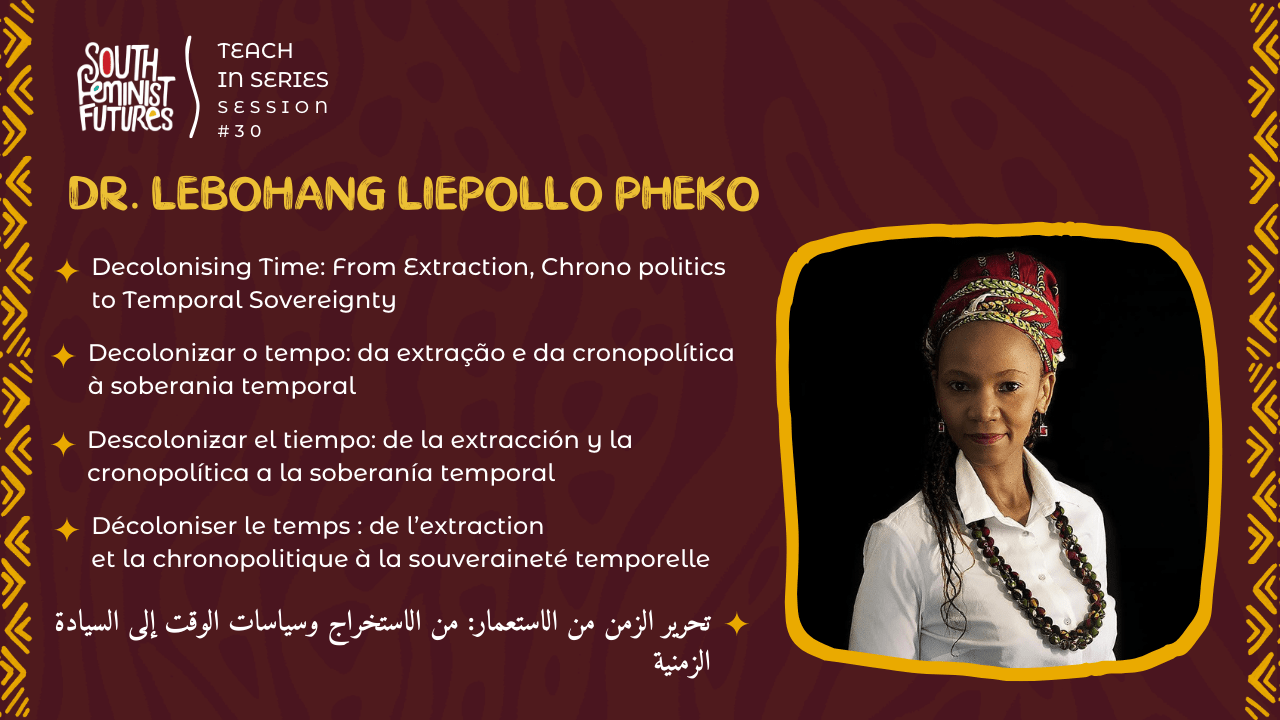
Time Theft and Temporal Justice: Decolonising the Clock
Lebohang Liepollo Pheko’s teach-in, titled Time Theft and Temporal Justice: Decolonizing the Clock, begins with a provocation: time is not merely something we spend, but something that can be stolen, inherited and reclaimed. She argues that time theft is embedded in the architecture of colonialism, racial capitalism and patriarchy. Capitalism converts time into surplus value, and colonial modernity reorganizes whose time and personhood are valued or disposable. On top of that, patriarchy stabilizes this extraction through reproductive time expropriation. Temporal justice therefore requires structural redress and the restoration of sovereignty over hours, rhythms and futures.
Pheko first challenges the idea that time is neutral. Before colonial disruption, African temporal systems were ecological, cyclical, relational and socially embedded rather than governed by linear progress or the commodity logic of the clock. She cites Adam’s Calendar in Mpumalanga, the Timbuktu manuscripts and Great Zimbabwe. Time could be marked through seasons, harvests, menstrual cycles, marriage and children’s ages; processes that mattered socially and for the community. The colonial stereotype of “African time” as laziness or backwardness erased these temporal sovereignties and justified civilizing missions, symbolized by missionary clocks. What is called slowness may instead be a recalibration toward one’s own rhythm.
She then introduces chronopolitics, drawing on Sarah Sharma, as the governance of time through acceleration, delay, extraction and hierarchy: who waits, who is rushed, who works and who rests. Neoliberal slogans such as “time is money” and hustle culture weaponize rest, while wellness and mindfulness are resold as commodities. Colonial chronopolitics replaced ecological rhythms with quotas and deadlines. In the Congo rubber regime, labor was compressed beyond ecological limits and enforced through hostage-taking, mutilation and terror; men were forced into forests while women maintained subsistence under duress. The transatlantic extraction of African people likewise stole laboring hours, childhoods, family life and dignity, converting them into European capital.
Pheko then examines Southern Africa’s oscillating migrant-labor systems, where men were confined to mines and compounds while women sustained households, agriculture and social reproduction. Contemporary border regimes reproduce temporal suspension: migrants in Libya and at the US-Mexico border lose years to detention, bureaucracy and indefinite waiting. Reproductive time expropriation is equally central. Women perform most unpaid care labor and spend billions of hours collecting water. Black domestic workers’ time was historically treated as infinitely extractable and legally invisible. Structural adjustment intensified these burdens, using women’s hours to subsidize debt repayment and neoliberal restructuring. The “strong Black woman” trope naturalizes endurance while concealing intergenerational exhaustion.
Time theft compounds across lifetimes through lost education, suppressed asset accumulation, reduced life expectancy, landlessness, displacement and incarceration. The carceral state suspends and erases futures, while inadequate transport, water, clinics and racialized spatial planning ensure that not everyone possesses the same twenty-four hours. Ecological destruction is also generational time theft: monocultures, mining and extractive global chains shorten communities’ recovery time. Pheko connects Bangladeshi labor, Congolese children mining cobalt and migrant care workers separated from their families to a system in which some people’s time is consumed to save time for others.
Temporal justice must confront racialized, gendered and imperial time theft through time sovereignty. Pheko’s structural reparative framework includes universal care income, time-reparation funds, public time infrastructure, land reform, ecological restoration, debt cancellation and refusal, reduced working hours, labor protections and carceral abolition. Reparations must also involve epistemic restoration, as memory determines whose suffering and contributions are recognized. Colonial power succeeded partly by making African people forget themselves and imagine that nothing existed before the colonial encounter. Reparations must therefore “reopen time” and return futurity to those denied it.
In the discussion, Pheko critiques donor logframes, quarterly benchmarks and short funding cycles as coloniality of time: fast, linear, auditable regimes that override community rhythms and cast the majority world as perpetually “behind”. She names three feminist priorities: redistribute social reproduction, resist acceleration and productivity regimes, and institutionalize time autonomy, including the right to rest, disconnect and refuse overwork. African cosmologies invite us not to “spend” time but to live, share, remember and experience it relationally. Burnout is not personal failure but resistance to the “too-muchness” of infinite extraction. She closes by warning that AI intensifies the cult of speed while hiding content moderators and data laborers, and that patriarchy appropriates some people’s time so others may purchase leisure. She concludes powerfully: to steal time is to steal life, and temporal justice is the reclamation of stolen mornings, generations and futures, with interest.
Liked this article? Share it!


