
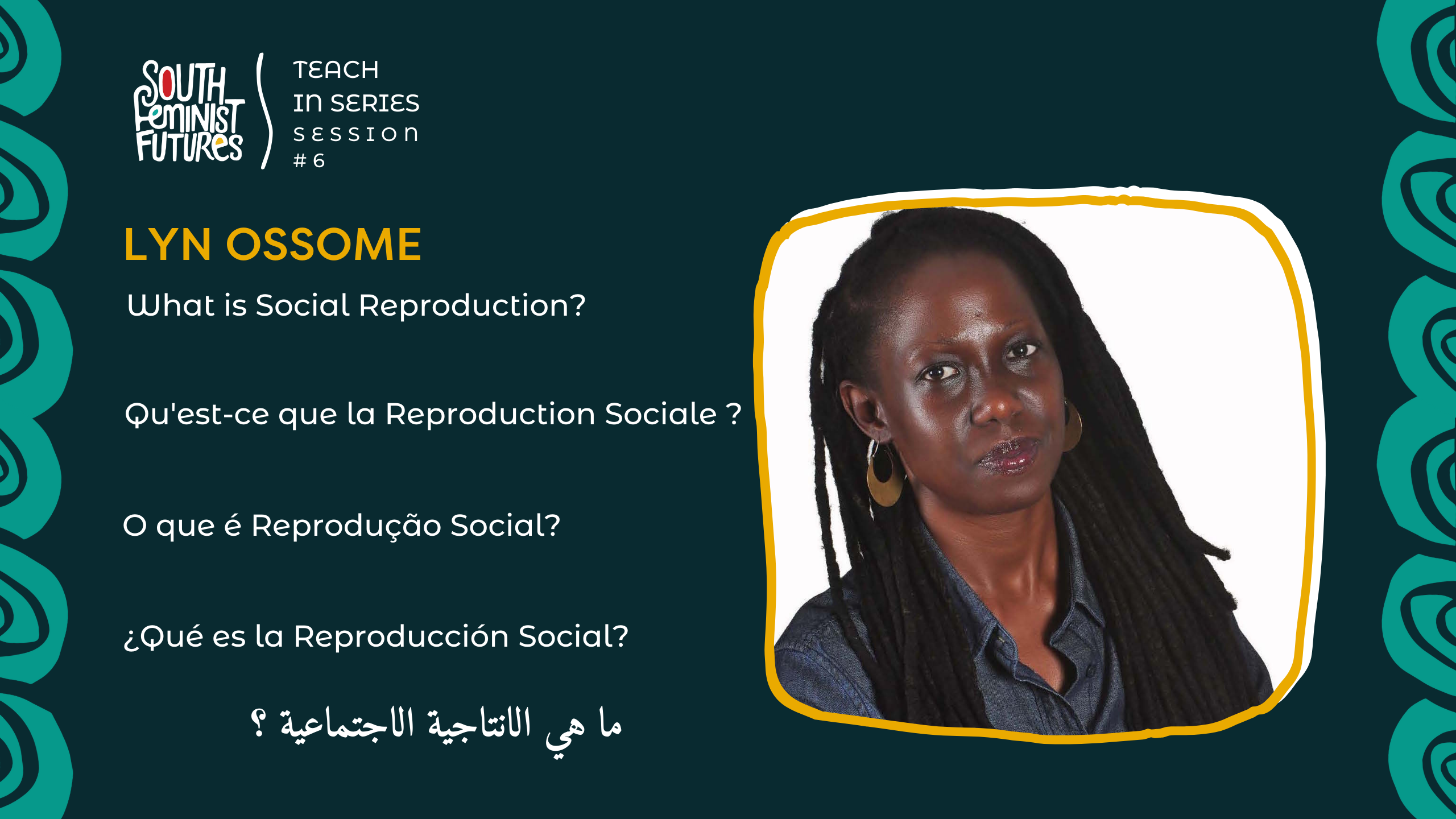
What is Social Reproduction?
In this teach-in, Professor Lyn Ossome first broadly discusses the theory of social reproduction, and then delves into an analysis of social reproduction in agrarian contexts. Her critique is informed by Marxism and feminist thought around social reproduction, but expands on both through context-based analysis. She argues that we need situated knowledge, analysis, and solidarity to understand the question of social reproduction, using African agrarian social structures to show how ongoing and structural dispossession of land and resources in the global south shapes social and economic systems and dynamics.
Social reproduction, capitalism, and feminist analysis
Prof. Lyn begins by describing the elements that make up what we understand as social reproduction. It refers to:
- biological reproduction
- the tasks we perform for, or that support, everyday survival (care work, domestic work)
- the accumulation of the skills we need to perform these tasks; and the education and acquisition of skills we need to participate in capitalist production
The capitalist economy commodifies and exploits labour for wealth accumulation and surplus value, and in turn provides working class households with the wages needed for everyday survival. While capitalism needs both social reproduction and production to be sustained (where reproduction allows for production, which allows for reproduction, and so on), the capitalist system separates the two processes.
As care work and domestic work are performed to a majority extent by women and marginalised communities, and is most explicitly needed for survival in working class households, Ossome argues that capitalism is intertwined with patriarchy and other systems of oppression (racism, heteronormativity, classism).She describes how feminist thinkers have brought in the lens of political economy to highlight these hidden connections between the gendered household structure and the reproduction of the capitalist economy and social relations. In doing so, they have built on Marxist analysis—which defines how surplus value is extracted from workers but did not necessarily elaborate on the social reproduction through which this happens—and they have shown how the capitalist system reinvents itself through its entanglement with certain value systems. Ossome also brings in the point of why those oppressed by this economic structure continue to perform the labour needed to sustain it, arguing that it allows for a certain membership in a society built on historically exclusionary and colonial value systems. In describing this, she adds a decolonial lens to feminist analysis, describing that colonised people cannot only see themselves as gendered, but that their race, ethnicity, class, faith, and sexuality cross-cut into this dynamic. While oppressive value systems push these communities to the margins of the economy, forcing them to participate for their own economic security, the capitalist system exploits this need in order to gain more commodified labour and production.
The institutional structure of capitalism
Prof. Lyn outlines how 3 institutions constitute the relation between wage, labour, and capital, and are thus fundamental to how capitalist society organises itself:
- Family / household, which is the primary social locus for shelter, feeding, nurturing, health, consumption, and reproduction of the labour power through sustenance.
- The political state, which retains a social contract between itself and its citizens, and provides interventions in order to govern and bring political stabilisation.
- Market / economy, which is produced through waged labour.
There are secondary institutions within the system, such as autonomous collectives (self-help organisations, savings groups, neighbourhood committees…), interventions from ruling classes (philanthropy, charity, church organisations…), or employer provisions (subsidies, insurance, pension…).
Analysing how social structures are upheld by these institutions shows how governing systems are intertwined, but also how the capitalist economy is at its core an obsolete one that is unable to reproduce itself without care and domestic work. It also needs state intervention for stabilisation, especially in times of crisis (such as the covid pandemic, where the state had to step in to provide materials for consumption when production was disrupted), and secondary institutions, which help working class families sustain themselves outside of wage labour.
The agrarian context
Prof. Ossome takes this in-depth analysis and relocates it to the agrarian context, going beyond the relation of exploitation that exists in the market to thinking about the relationship that people have with the land. In this way she is expanding on both Marxist and feminist theory, using the context of the Global South to shift the framework of social reproduction to be less Western-centric. In the Global South there is a large surplus population (those who do not enter the labour market), an active peasantry, and a failure of neoliberal capitalist growth where there is actually deindustrialisation, a diminishing proletariat, and an expanding informal economy made of petty commodity production. These conditions convolute direct exploitative relationships, and raise questions of sustenance amidst unemployment and expulsion.
Prof. Lyn argues that there is an economy taking care of this surplus population that is not reliant on production under capitalism, posing the question of how the system then reproduces itself. She highlights that working class households in this context rely on a combination of incomes from at least three domains: wages, petty trade, and state interventions. However, she also presents the peasant unit as one that is productive, not just reproductive; producing goods and services to sustain itself rather than converting them to use value. So, in a context where land and resources are accessible, they can be used directly for sustenance without necessarily passing through the market.
While the structure of the peasantry has critiques and contradictions of its own, this link to the land is essential for survival and Ossome argues that we must insist on its enduring relevance. Neoliberal states tend to frame farming as no longer relevant to the economy or survival, and often use the example of decreased GDPs in agrarian contexts as talking points against land and agrarian reforms. However, Prof. Lyn says that our survival depends on land, particularly as capitalism no longer needs a massive work force, and as we live through climate change and multiple other crises that monopoly finance capitalism brings about.
Accountability and solidarity
In the Q&A, Prof. Lyn addresses questions around accountability and solidarity within the exploitative capitalist economy. She brings these issues back to context again, arguing that under certain social structures, the relationship between reproduction/the household and production/the economy is not so clear cut. She reiterates the importance of the decolonial feminist lens, reminding us that gendered labour and capitalist accumulation is a colonial inheritance, and again that governance seeps into social life in the form of oppressive value systems. These systems are upheld by the state, which has transformed from being sovereign to being financialised and part of the political economy—it still does grant rights, but it also grants capital. With so many actors and systems in play, Ossome argues that we need to form analysis and solidarity with all those who struggle under these entangled structures.
Summary by: Talah Hassan
Liked this article? Share it!


