
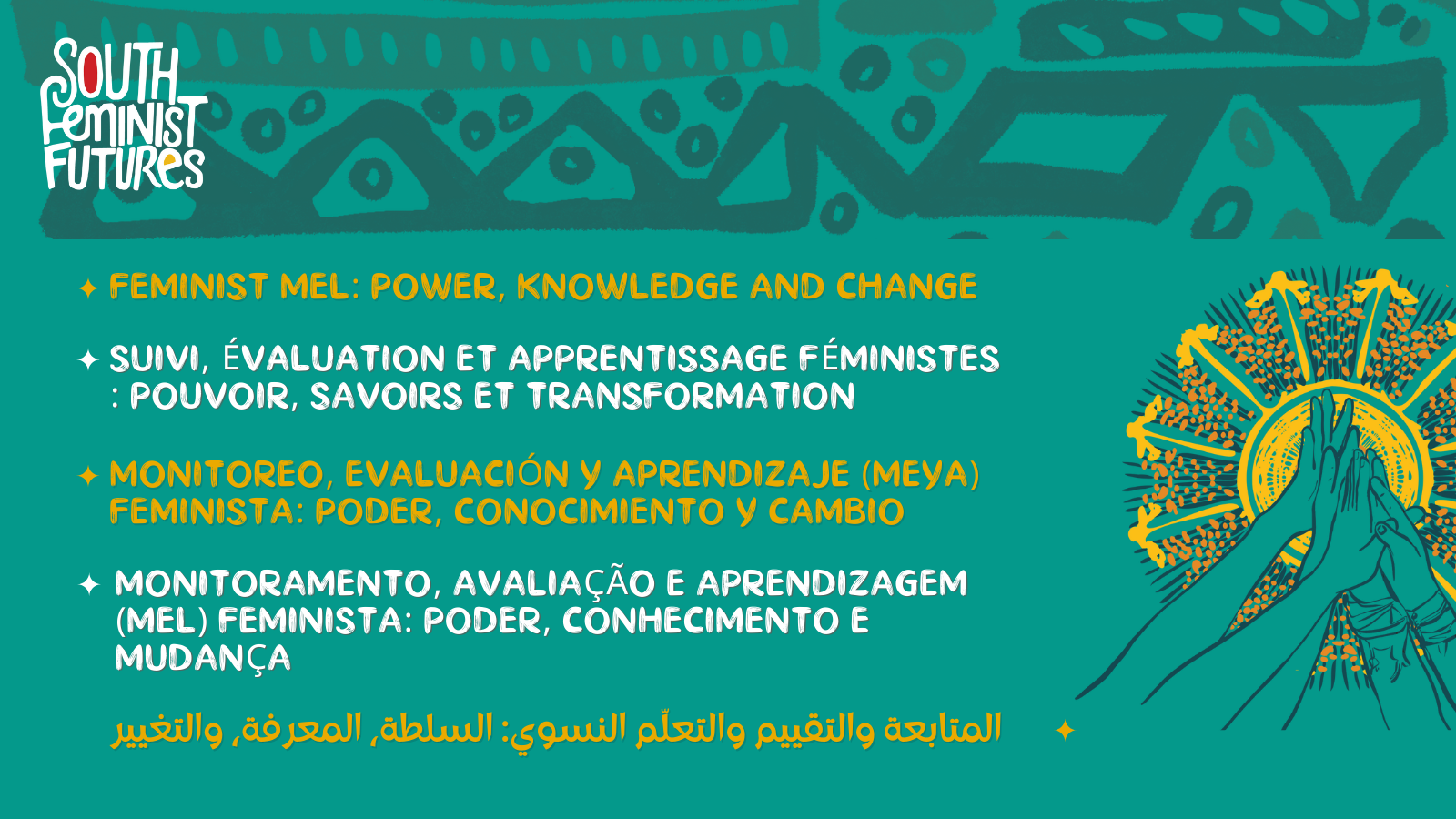
Reflections from the Workshop on Feminist Monitoring, Evaluation & Learning for Communications and Knowledge Building
Organised by APWLD | Chiang Mai, Thailand | 6-7 December 2025
By Debarati Das
In December 2025, we the South Feminist Futures (SFF) team participated in the workshop on Feminist Monitoring, Evaluation & Learning (MEL) for Communications and Knowledge Building, hosted by the Asia Pacific Forum on Women, Law, and Development (APWLD) in Chiang Mai, Thailand. The workshop brought together feminist organisations and activists from across the Asia Pacific region.
The workshop combined feminist critiques of dominant MEL paradigms with collective thinking grounded in movement and organisational realities. Rather than treating MEL as a technical exercise, the conversations centered political purpose and strategy, with clear implications for how feminist movements approach monitoring, evaluation and learning with knowledge production and communications work.
The workshop interrogated the language of “monitoring” and “evaluation” itself. These terms often signal top-down oversight and funder-driven accountability, reinforcing extractive dynamics and tick box approaches. In response, participants explored ways of reframing MEL as a process oriented toward learning and shared transformation instead of linear notions of “progress.” Feminist MEL must honour movement knowledge, foreground accountability to communities, and function as a tool for strategy and systemic change.
Political Purpose of Feminist Communication and Knowledge Work
The opening session grounded the workshop politically, by situating feminist communication and knowledge work within conditions shaped by authoritarianism, digital surveillance, shrinking civic space, and the co-optation of feminist language by states and institutions. The discussion emphasised that clarity of political purpose is a necessary starting point for any meaningful MEL practice.
Participants affirmed that feminist communication and knowledge work is fundamentally political. This work contests dominant state- and market-produced narratives, makes visible structural and historical forms of violence, and supports feminist movement memory and strategy. It also reasserts Global South feminists as producers of knowledge, challenging methodologies that reduce us to sources of “data.”
In this framing, impact extends beyond visibility and the creation of alternative epistemic spaces is foregrounded as a core form of impact. This perspective resists approaches that reduce communications and knowledge work to depoliticised, technocratic “advocacy outputs” and/or donor-facing deliverables. Being clear about who a piece of work is for and what it seeks to shift — alongside a clear sense of what forms of impact it does not prioritise — can sharpen learning and strategic focus.
Rethinking Impact and Change
The workshop then turned to questions of impact and change. The discussion focused on how communication and knowledge work can contribute to intended shifts, while deliberately moving away from linear and transactional impact models..
From a feminist perspective, the most important impacts identified were often subtle and relational: shifts in language and framing within movements, increased analytical clarity and confidence among activists and practitioners, strengthened solidarities across movements, and a greater ability to name structural causes rather than individualised symptoms. These forms of change are slow and non-linear, and rarely attributable to a single output.
This critique challenges linear logframe thinking, which assumes rigid timelines and measurable outcomes. Feminist knowledge circulates through reuse, reinterpretation, informal sharing, and collective sense-making. Impact often emerges long after a publication or event, and in contexts the original producers may never witness.
This suggests the importance of MEL approaches that can hold non-linear and relational change. Learning can focus on documenting stories of use and adaptation over time. For example, this might include capturing reflections from contributors or facilitators across activities, inviting voluntary feedback on how engagements shaped participants’ thinking, and noticing recurring themes or questions that surface over time. Tracking visible references to a body of work in public writing or movement spaces can also offer insight into how ideas circulate, without relying solely on attendance figures or short-term feedback.
Practices and Challenges In Monitoring and Evaluation
1) Structural limits of dominant MEL frameworks
A recurring theme throughout the workshop was a shared critique of dominant MEL frameworks developed within Global North institutional contexts. These frameworks often sit uneasily with feminist movement work in the Global South.
Linear, results-based approaches assume stable political environments, despite the reality that many feminist organisations operate under conditions of repression and uncertainty. Attribution-focused models individualise impact and obscure the historical and collective nature of movement change. Standard indicators privilege visibility and scale, relegating work that is intentionally low-profile or prioritises safety. Donor-driven reporting cycles frequently impose timelines misaligned with feminist organising rhythms and knowledge production processes.
These critiques were framed as a rejection of extractive accountability regimes that demand legibility and measurability without adequate attention to context, power, relationality, or risk.
2) Limits of common MEL practices
Participants reflected candidly on MEL practices that consume time and resources without generating meaningful strategic insight. These included heavy reliance on digital analytics tools designed for commercial media environments, evaluation templates that reduce complex feminist learning to numerical summaries, and externally driven evaluations led by consultants unfamiliar with movement realities. Additionally, one-off evaluations that produce reports without sustained learning, and that treat MEL as an afterthought rather than an integral part of programme design, were identified as persistent challenges.
3) Gaps in existing monitoring practices
When examining existing monitoring practices, participants noted that responsibility often falls on communications teams because of their proximity to “outputs.” Learning, however, remains fragmented or informal.
The discussions identified several gaps. Collective reflection across teams is limited. Monitoring prioritises outputs over meaning-making and data is often collected without being synthesised into shared learning. Existing MEL systems can reproduce organisational hierarchies, with information flowing upward rather than horizontally across teams or outward to movements. These gaps highlight the need for light-touch but intentional internal learning rhythms, such as regular cross-programme reflection notes that feed directly into strategy.
Alternative Feminist MEL Practices
In contrast, participants mapped practices more closely aligned with feminist values that often remain informal or under-recognised in existing MEL systems. These included collective reflection spaces embedded in ongoing work and narrative and story-based documentation. We also need explicit recognition of non-linear change shaped by experiences of “queer time” and “crip time.” Peer learning within teams and across regions and organisations was consistently highlighted as valuable, alongside flexibility to revise indicators as political and organisational conditions shift. The discussion emphasised the importance of explicitly naming and strengthening these practices as MEL.
1) Audience mapping and power analysis
Audience mapping was framed as a form of power analysis. Participants reflected on the gap between intended audiences and those most easily captured through digital metrics.
The most important audiences for feminist knowledge work — such as structurally excluded communities and grassroots organisers — remain least visible in conventional monitoring systems. These groups may avoid public engagement or digital traces due to surveillance, lack of access, repression, or safety concerns. This raised critical questions about strategic prioritisation, including the necessity of consciously choosing not to centre certain audiences or metrics when doing so compromises security or feminist political commitments.
2) Feminist indicators for communication and knowledge work
A significant portion of the workshop focused on reimagining indicators from feminist perspectives, with movement-building placed at the centre of impact.
Proposed indicators reflected this shift: noticing when materials are reused or adapted; when feedback signals shifts in analysis or confidence; when relationships and networks are strengthened through knowledge work; and when knowledge circulates in ways that enable collective action or political intervention. Consent, attribution, and accessibility were identified as indicators in their own right, alongside visible references to work in movement statements, curricula, research, or public interventions. Invitations to collaborate, internal shifts in framing or priorities, and sustained engagement over time were also recognised as meaningful signals of impact.
Importantly, ethics itself was framed as an indicator, challenging MEL systems that treat ethical considerations as external or secondary to measurement.
3) Participatory MEL approaches and tools
The workshop explored participatory approaches that position learning as a shared and negotiated process. This included co-defining success with collaborators and communities, rather than imposing externally determined criteria. In this framing, success was shaped by the priorities and realities of those most affected by the work.
Participants emphasised embedding reflection into existing spaces such as team meetings, workshops, and convenings, enabling learning to happen in real time. Sharing findings back in accessible formats — through visual summaries, storytelling, local languages, or community briefings — was seen as essential to accountability and usefulness. Strong caution was expressed against one-off consultations without follow-up, which risk reinforcing power imbalances and eroding trust.
Creating feedback loops, ensuring participation across roles and levels, and continuously interrogating power within learning processes were identified as core feminist MEL commitments: questions of who sets learning agendas, who interprets data, and who benefits from the learning must remain central.
4) Digital security and risk
Digital security emerged as a central MEL concern. Participants discussed risks linked to surveillance, platform dependence, and the unintended exposure of activists or communities through data collection and reporting.
Feminist MEL requires deliberate decisions about what not to collect. Data minimisation and aggregation or anonymisation must be framed as feminist practices. Before adopting new tools or indicators, organisations need to assess potential risks and prioritise safety over data completeness, particularly in politically sensitive contexts.
Strengthening Feminist Learning Infrastructures
Overall, the workshop emphasised that feminist MEL is fundamentally about building shared learning infrastructures grounded in politics and accountability, and practices that honour movement knowledge, resist extractive logics, and sharpen collective strategy over time.
This calls for intentional learning infrastructures that are politically grounded and oriented toward collective reflection, community accountability, and long-term strategy rather than extractive, one-off data practices. Approached in this way, MEL strengthens feminist movement memory and supports long-term transformation, instead of functioning as a compliance exercise.
Conclusion
Reflection, learning, and accountability are deeply political practices. Dominant MEL systems were not designed to understand transformation; they were designed to monitor compliance. Rooted in colonial logics, they prioritise surveillance, financial control and reporting, and funder control over movement growth and long-term change. In this sense, MEL often becomes a tool for monitoring activists rather than supporting transformation.
Feminist communications and knowledge work disrupts these logics by creating alternative epistemic spaces whose impacts are slow and often difficult to quantify. Approaching MEL with clarity of political purpose and accountability to movements, while remaining attentive to power, enables learning to strengthen feminist strategy and sustain movement memory in ways that support long-term transformation rather than reproducing colonial control.
SFF offers the readings below as further points of reference for those wishing to deepen their engagement with feminist MEL:
Batliwala, S. Strengthening monitoring and evaluation for women’s rights: Twelve insights for donors. Association for Women’s Rights in Development (AWID). https://www.awid.org/sites/default/files/atoms/files/strenghteningme.pdf
FRIDA (2022). Collectively imagining what feminist MEL looks like: Introducing FRIDA’s Strategic MEL Framework. Young Feminist Fund. https://youngfeministfund.org/collectively-imagining-what-feminist-mel-looks-like-introducing-fridas-strategic-mel-framework/
Count Me In! Consortium. Feminist PMEL (Planning, Monitoring, Evaluation, and Learning). https://cmiconsortium.org/feminist-pmel/
Bani, S. (2024). Exploring feminist approaches to monitoring, evaluation, and learning (MEL). Feminist Opportunities Now. https://feministnow.org/exploring-feminist-approaches-to-monitoring-evaluation-and-learning-mel/
Outcome Mapping Learning Community. https://www.outcomemapping.org/
Written by Debarati Das

Debarati Das (they/them) is a queer non-binary feminist based in India. As the Knowledge and Research Programme Assistant at South Feminist Futures, they work to build, enhance, and sustain the Knowledge Hub to support Southern feminist activism. Their work has primarily centered women, queer and trans persons, and disabled individuals’ experiences of online harms and freedoms. Their interest lies in reimagining digital worlds through anti-colonial, feminist and queer lenses, where technology becomes a site of resistance, solidarity, creativity, and collective transformation. They’re curious about infrastructures of memory: how technologies, archives, and epistemologies shape what is remembered, who is heard, and whose knowledge counts. Currently, they’re an independent consultant also working in the areas of technology research and anti-colonial tech.
Liked this article? Share it!


