
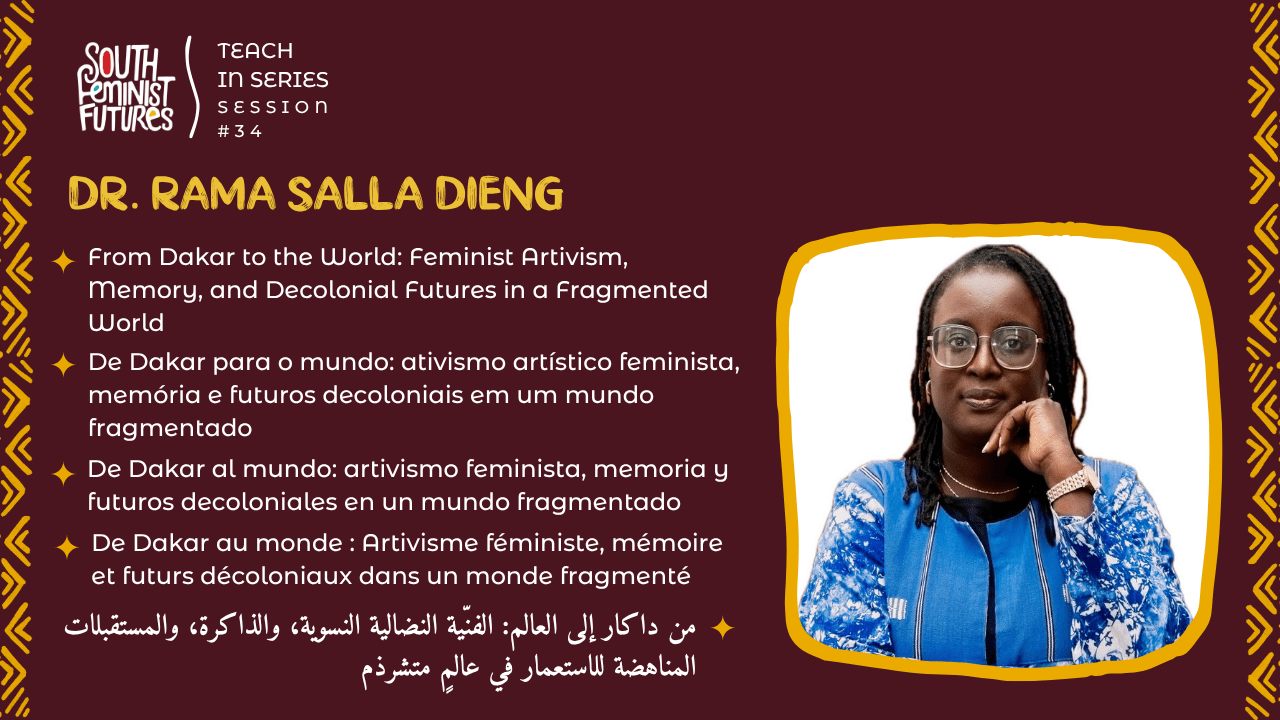
Feminist Artivism, Memory, and Decolonial Futures in a Fragmented World
In the last session of our teach-in series on feminist political economy (for the time-being!), Rama Salla Dieng explored feminist artivism as a practice of memory, political intervention and world-making. Taking Dakar as her starting point, she challenged the assumption that universal ideas must travel from the Global North to the rest of the world. Instead, “from Dakar to the world” in the title of the session solidifies Dakar as a centre of intellectual, artistic and political production from which global questions about liberation, belonging and justice can be addressed.
Dieng situated the discussion within the legacy of the 1966 First World Festival of Black Arts (FESMAN), which brought artists, writers, intellectuals and political figures from more than 30 countries to Dakar. The festival positioned culture as a tool of dignity, liberation and Pan-African solidarity. However, its rightfully celebrated history still contains historical silences. The dominant story of Pan-Africanism often centres prominent men, producing what Dieng described as “man-Africanism,” while overlooking the women who organized, wrote, performed, filmed, published and built the institutions that sustained these movements.
To unearth these histories, Dieng highlighted several Senegalese cultural pioneers. Journalist, writer and organizer Annette Mbaye d’Erneville helped lead AWA: La revue de la femme noire, a pioneering magazine created by and for Black women. Through writing, collective publication and transnational collaboration, AWA connected women across linguistic and political borders and treated women’s struggles as political struggles. Its history also demonstrates the importance of controlling the means of cultural production: publications such as AWA often disappeared not because they lacked ideas or audiences, but because women lacked the exclusice financial and institutional resources needed to sustain them.
Filmmaker and anthropologist Safi Faye offered another model of artivism. Her films centred rural and peasant communities and addressed questions including food sovereignty, debt, migration, motherhood and women’s lives. She worked in Serer and understood her own community as her primary audience, raising a crucial question for feminist cultural workers: Who are we creating for, and whose recognition are we seeking? Germaine Acogny, meanwhile, transformed dance into an enduring cultural institution through the École des Sables, demonstrating how artistic practice can create infrastructures that continue to shape future generations.
These examples led Dieng to describe memory itself as a site of struggle. “Radical remembrance” involves searching for women who have been reduced to footnotes, preserving their work, digitizing endangered archives and retelling their stories. Remembering means bringing together what has been dismembered by colonialism, patriarchy and institutional neglect. Archives are therefore not neutral collections: they determine whose lives become part of history and whose knowledge remains available to future movements.
Dieng connected these earlier histories to contemporary feminist artivism through a recent interdisciplinary residency linked to CineFemFest. Writers, filmmakers, photographers, researchers and activists worked together across the boundaries separating scholarship, literature, cinema and visual art. The resulting collection, Writing, Filming, Photographing to Resist, treats first-person experience as a legitimate source of knowledge. Its contributions address gender-based violence, legal impunity, land and environmental justice, spirituality, diasporic identity, representation and feminist institution-building. The project demonstrates that the personal is political and epistemological. Lived experience can help generate theory, archives and strategies for transformation.
During the teach-in, Dieng also emphasized the contested meaning of culture. Culture can be invoked to defend harmful practices or exclusion, as seen in attempts to portray anti-LGBTQI+ politics as cultural sovereignty. Yet historical memory shows that queer people and diverse forms of gender expression have long been part of African cultural life. A feminism or sovereign politics that denies full citizenship to part of the population is therefore fundamentally incomplete.
The session concluded with a practical call to write, publish, film, photograph, digitize and preserve. Feminists must enter every space in which their stories need to be told, develop their own platforms and become contemporary griots: knowledge producers, educators, artists, archivists and agents of social transformation. By carrying women’s stories forward, feminist artivism turns memory into resistance and imagination into decolonial futures.
Liked this article? Share it!


