
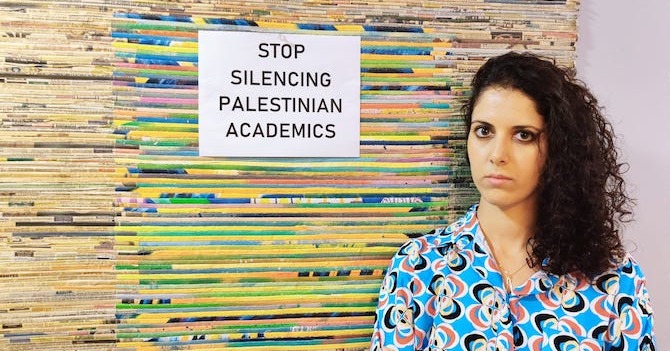
‘Gender, sex and genocide: the imperative of anti-imperialist solidarity’ is the twenty-first session of our Political Economy Teach-in Series. It was held on March 25, 2025, and delivered by Walaa Alqaisiya.
Dr Walaa Alqaisiya is a professor of Middle East Studies at Northwest University in the People’s Republic of China. She is the author of the book Decolonial Queering in Palestine (published with Routledge in 2023) and has been widely published in many renowned journals on the topics of decolonial and anti-imperialist theories, gender and sexuality and Palestine liberation.
In her teach-in, Professor Walaa reflects on the gendered and sexed logic of the genocide in Gaza. She discusses the colonial gender system and the occupation of gender, racialised and sexualised dehumanisation, and the process of “ungendering” that underlies the imperialist “economy of waste”—an economy of accumulation through death, the death of Palestinians who have been reduced to sites of ungendered flesh by the Zionist settler colonial project. Walaa speaks through the lens of anti-imperialist, decolonial queer feminism, wherein she argues that western feminism, including queer feminism, can serve US imperialism and Zionism by centring identity and abstracting it from material realities. She pushes for Global South-led revolutionary theory and praxis in which queer and Palestinian struggles are intertwined, and where resistance as “defiance rising out of abjection” is central to liberation.
Palestinian feminists often find themselves competing or asking for space within international bodies for advocacy and organizing. Do you see value in being present in all international body spaces? What meaningful role do you think Palestinian feminists can play in such spaces?
I believe that one of the main points of disagreement within Palestinian feminist circles, which affect the kind of “feminism” we want to occupy and rally under, is how we conceptualise the existence of the Zionist entity and its organic and historical linkages to wider anti-imperialist and capitalist structures. Since the 1990s, with the signing of the Oslo Agreement, we have seen the rise of feminist “femocrats” who became part of the NGOized feminist movement working under the Palestinian Authority (PA) apparatus. The May Uprising or the Unity Intifada Uprising which took place in 2021, which I wrote about here, was a moment to see the crystallisation of such contentions within Palestinian feminist and wider socio-political spheres. The confrontation with the PA in the aftermath of the killing of a political and very popular opponent, Nizar Banat from South of Hebron, has shown how this Oslo induced apparatus is one that serves and normalises the settler colonial regime. The Oslo PA regime is manifesting this very fact during the ongoing genocide in Gaza. Within these moments of confrontation within the Palestinian political scene between forces of resistance versus normalisation, we also see the accentuation of tensions between those feminists who belong to the liberal camp of “law and order” under the status quo, and others who insist on more radical versions of feminism. For example, back in May 2021, we saw Palestinian women dressed in blue cop attire attack Palestinian women protesters. The former belongs to a space of “feminism” that the Oslo regime has created to rally the power of “internationalising Palestine” through gender programming agendas, whose primary task is to appeal to Western institutions though things like “gender mainstreaming” or “women rights” under occupation. This kind of feminism only advances the needs and interests of the certain social classes, mainly PA elites and the femocrats and NGO-makers who support them, whilst attacking and erasing the social value of decolonial and anti-colonial feminist trajectories.
Any word of advice for individuals new to the feminist anti-imperialist movement? And do you have any common pitfalls that we should not engage in when going into conversations about these topics?
Keep organising and mobilising, not simply through random or spontaneous flows of energy but through a well-planned and well-studied approach to political organising. Palestine and the rescue of humanity from the savage forces of imperialism requires more than quick outbursts into the streets, although angry protests are also vital. What I mean to say, is that there is the need for patient, strong-willed, and persistent efforts of building and contributing to the growth of the movement through party building and raising consciousness, within the movement and beyond, via the ideological tools (i.e., Marxism-Leninism with Southern characteristics) that can help us rise to the task of History-making. Perhaps, to avoid common pitfalls, we can turn to the words of Constantine Zurayk when he proposed that the task ahead is a “civilizational project rather than a defensive obsession with identity boundaries in need of protection”. I guess what I am trying to say here is, do not let the liberal fixation on identity, its affirmation or negation, stifle or hijack the real work required on the ground for the rescue of humanity.
You talk about moving away from a politics of identity. Some scholars promote a politics of values over a politics of identity. What are your thoughts?
I adhere to a politics of progressive internationalism that is rooted in struggle against US-led capitalism/imperialism and that takes as its primary objective—in the case of the Arab world to which I belong—the task of striving for socialism that is nonetheless tied to the specific heritage, culture, and social formations of the Arab nation and its needs to develop to realise its civilisational potential.
At the present moment, what does meaningful anti-imperialist solidarity look like?
Meaningful anti-imperialist solidarity entails educating oneself on what imperialism means. By that, I mean developing an understanding of the term via the relevant theoretical framework, which is not simply about abstract theoretical jargon, but it serves the purpose of providing the right diagnosis of the current course and functionality of imperialism to change it. Theory guides actions, and vice versa. Similarly, solidarity is not a simple word that folks should throw around whenever they feel like they have attended the right amount of street rallies for a cause. Rather, as I said above, solidarity is when your whole life and the way you thought you saw it or understood it faces a deep existential and political crisis. This is because there is an awakening at the level of the consciousness that you never experienced before and this awakening is propelling you to do some radical action, which begins with the self but then enfolds the kind of vision for justice that extends to the rest of the world. Simply put, anti-imperialist solidarity aims to destroy [forces and structures of imperialism/capitalism] in order to put something else in place. Sometimes, we know very well what needs to be destroyed or plucked out of our lives to live with balance and peace, but we often fail to know what we should be building in the same simultaneous process.
In your article, you mention the need to recover alternative epistemologies. What examples can you provide, and what do you think of the state of knowledge production in SWANA?
I have just finished editing a volume (to be published with Routledge this year) that takes this very concern at its core. Titled Palestine and the Western Academe: Fighting the Exception, Defending Epistemic Justice, the volume aims to bring attention to the Western academe’s role in the advancement of certain epistemologies that have worked to reproduce, rather than question, the social imperatives for the continuity of Western imperialism/capitalism. I think that Palestine and the struggle for justice it enfolds can direct a lot of what we mean by “alternative epistemologies”. For example, we should take inspiration from the legacy of epistemic disobedience that Palestinian engaged intellectuals like Refaat Alareer, Basil Al-Araj and others have lived to embody and advance for the rest of us in the Global South. Epistemic disobedience entails the capacity for the south of the world to produce knowledge imaginatively and indigenously, as Edward Said once emphasized. In other words, intellectuals from the south of the world should avoid falling into the trap of copy-pasting Western imported theories and frameworks that do not work for the contexts in which they are based. If the service of a society that happens to be a peripheral one or one that is directly under imperialist aggression is our top priority as intellectuals, then there is a need for us to advance and practice epistemic delinking [dismantling the link between coloniality/imperialism and rationality/modernity under hegemonic knowledge structures]. This can take place by literally moving ourselves outside the hegemonic sphere of the Western academe to be able to craft knowledge with and for our fellow allies in the South. For those of us who remain stuck within Western academic institutions, the least that can be done is to actively and consciously advance pedagogic methods that can shake the parameters of academic obedience, revealing contradictions from within. What we have witnessed through the student Intifada encampments in various US and European universities and the increasing repression against staff and students is a significant demonstration of the real face of “free speech” and “democracy” that these same institutions wrap themselves with as “World-Class” universities.
How can a radical imagination for a different future be practiced in times of genocide?
I think I have answered this to an extent and it’s better for me to stop before I go into the pessimistic route. We are headed for the abyss if we do not WAKE UP! Waking up entails the capacity to imagine a different, more just world and the capacity for imagination can only be cultivated through direct action and strong human will, not mere thoughts. Think of how Palestinians in Gaza have been able, despite the amount of destruction and death, to still dream, smile, and advocate for justice. They post to you on social media every day to ask you to wake up and do something. Radical imagination is definitely much more than hitting a like or sharing a reel about Gaza. If we do not wake up the fire will catch us too, let that be the impetus for radical action.
Interview edited by Talah Hassan
Talah lives in Beirut and works in feminist knowledge production, from research, writing, and editing to conceptualizing and coordinating creative projects and workshops. She is trained in medical anthropology, with specific interests in sexuality and sexual health, politicized notions of care, embodiment, and the medical / mental health industrial complex. She is skilled in qualitative research methodologies, especially oral history and research ethics, and in qualitative data analysis. She co-founded and organizes with a local queer mutual aid group in Lebanon, alongside other feminist, leftist groups when possible.
Liked this article? Share it!


