
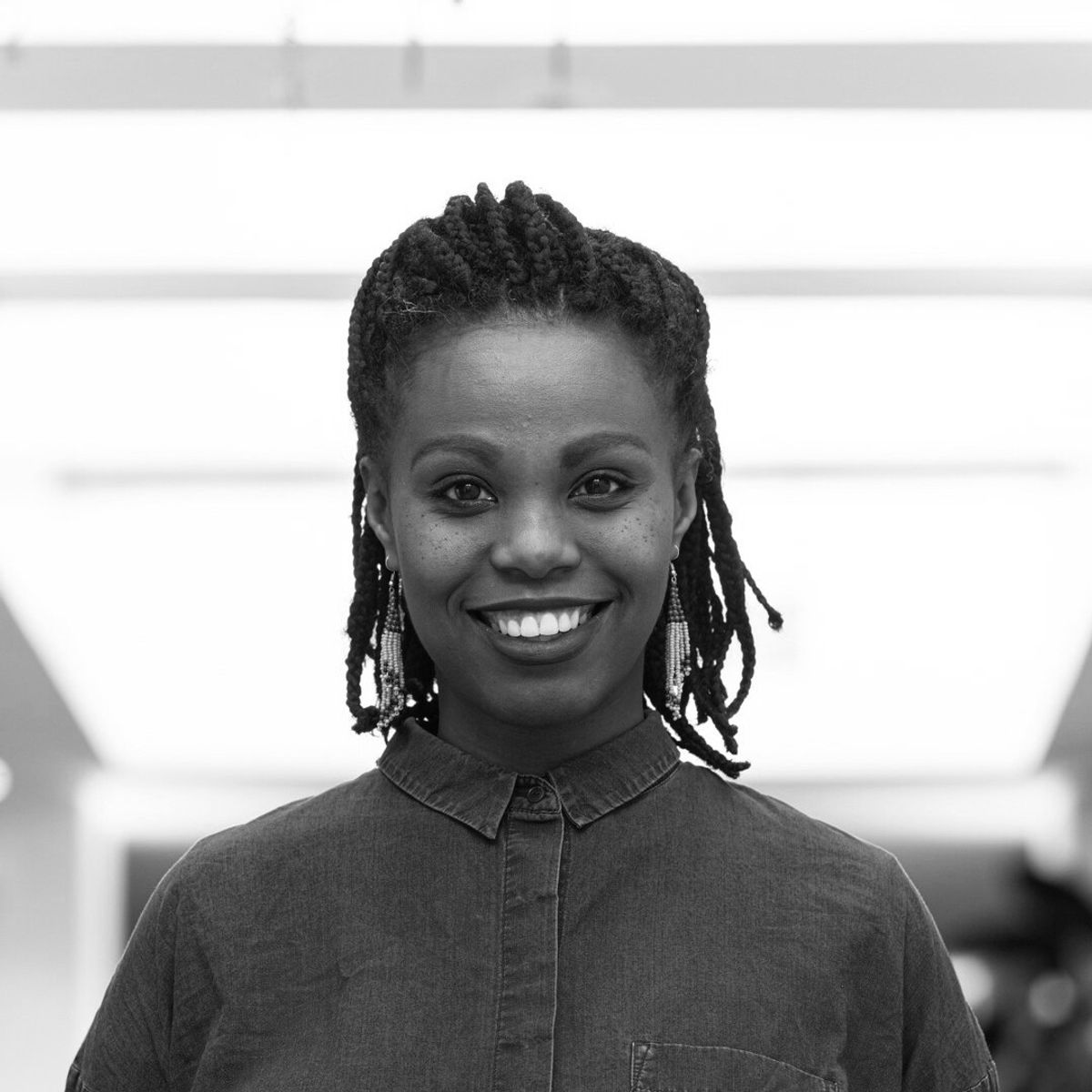
“Racial Justice and Reparations” is the fourteenth session of our Political Economy Teach-in Series. It was held on July 17, 2024, and delivered by Liliane Umubyeyi.
Liliane Umubyeyi is the co-founder and executive director of African Futures Lab, an organization whose mission is to tackle the culture of impunity and denial concerning historical and contemporary racial injustices across Africa and Europe. Prior to establishing African Futures Lab, Liliane worked in the field of international development (United Nations, International Centre for Transitional Justice, Lawyers without Borders, American Bar Association) on projects concerning access to justice for marginalized groups, transitional justice, and gender justice. This professional background and her lived experience in Africa (Rwanda, South Africa, Central African Republic) and in Europe (Belgium, France) inform her thinking about the decolonization of development policy and practice, the decolonization of international law and justice systems, and the possibilities for repairing historical and contemporary racial violence. Liliane holds a PhD in Law (Université Saint Louis Bruxelles (Belgium) and in Social Sciences (Ecole Normale Supérieure de Cachan (France), and her dissertation focused on apartheid victims’ mobilizations in South African and American courts.
In this interview, Liliane Umubyeyi answers questions around two main issues: the apartheid reparations process in South Africa, and the absorption of racial justice movements into artificial, symbolic actions within capitalism, a process she calls “racial justice washing”. Both these issues have, at their core, the dismissal of the violence that Black communities, and specifically Black women, face at the hands of both European violence and the capitalist system. Her advice is to listen to the critiques of those most affected, to stay vigilant, and to work towards incorporating the experiences of African women and women of African descent, with all their specificity, in our movements for racial justice.
Can you introduce yourself by sharing something that may not be in your biography?
I was born and grew up in Rwanda, and then I moved to Europe when I was 10. I go back sometimes because I have all of my family – my parents, my siblings – living there. So, I think I’m between two countries now, especially since I have my son and I would like to move back there.
That’s such an interesting and peculiar experience, to be between countries all the time. I feel like it affects our identity as well, right?
Yeah, it’s very common for Rwandans, you know. Because of the genocide and the political history, many of us have been scattered all around the world, and it wasn’t a voluntary move. We are trying to go back, but we still have links outside, so it’s difficult. You have a lot of people who are between countries, who have this in Rwanda and that outside of Rwanda.
I can imagine that the history of your homeland has influenced your interest in the topics that you study.
Of course, yes. The genocide against the Tutsi happened when I was almost 9. So I grew up in a tumultuous political context, and I became very aware of systemic violence, its implications, and the issues of justice at a very young age. I think it has influenced my topics of interest, both in terms of my studies and when I decided to work for human rights NGOs. So, I think it’s part of who I am.
So, I see that part of your work investigates the mobilisations of victims of apartheid in South Africa. To what extent do the reparations actions implemented in this country serve as a model for other countries?
One of the topics of my dissertation was to understand the ways in which this policy of reparations was challenged by apartheid victims’ movements. It was dividing, and some people still think that it shouldn’t be considered a model. I also agree that there are strong limitations to this model. I’m not going to go into much detail since there are so many limitations, but I can mention a few of them.
The first one is that the Truth and Reconciliation Commission (TRC) had a very strict and restrictive definition of racial violence under apartheid. So instead of looking at the structural violence of historical processes and the ways in which Black South Africans were systematically discriminated against over decades – in terms of socio-economic rights, spatial segregation, residential segregation, school education, employment, etcetera – the TRC focused only on violence that concerned physical integrity. So, murders, torture, ill-treatment – this was the kind of violence that was considered a form of violence that needed to be repaired. And this means that you are going to focus on a very narrow number of people and not consider the entire Black South African population as being targeted by the accorded policies.
I think that is one of the strongest critiques. Someone like Mahmood Mamdani used the term “diminished truth” because we had a very, very narrow definition of what we mean by apartheid violence, who could be considered a victim, and what could be repaired. I think, in the end, there were only 20,000 to 22,000 people who could be considered victims and could benefit from the reparations.
The second limitation that I see is that, basically, the violence committed by the apartheid state and its agents, and the violence committed by the resistance movements, were almost put on the same level. So those who were challenging the apartheid system and those who were implementing and pursuing the apartheid system were considered to be the same, as those who committed human rights violations. This is the second layer of the politicisation of apartheid violence, and that was also somehow challenged.
So, there are many limitations in terms of what type of violence we look at, who can be considered a victim, and what forms of reparation these people can benefit from. This is my perspective. It’s a political transition. It’s the dismantling of a system, so it’s not easy to say if it’s a model or not. But I think, for some people, these were some of the critiques that we must keep in mind.
The post-apartheid Truth and Reconciliation Commission in South Africa was also criticised by social movements for incorporating amnesty for perpetrators. Is this necessarily a barrier to building reparation policies?
I don’t think that amnesty is a barrier to the policy of reparations per se. In this context, amnesty was conditioned on four elements. The criminal act for which the person was asking for amnesty had to have a political motivation. Secondly, it had to have been committed between 1960 and 1994. Thirdly, you had to tell the whole truth. And fourthly, there was supposed to be a kind of proportionality between the act and the political motivation.
Was there something also about apologising to the victims?
There was nothing specific about apologising. But I think if you wanted to have access to, or be granted, amnesty, you had to fulfil these conditions. And if you didn’t, you would not be granted amnesty and you could be prosecuted. The problem in South Africa is that the people who didn’t ask for amnesty were not prosecuted, so the whole process lost its energy because the prosecution policy did not follow up. So, in this context, you could say the subsequent governments did try to also grant amnesty through other forms. I think the problem was the political context that didn’t follow the rules. But I don’t think that amnesty, per se, is a problem. What is important is that there is recognition of responsibility and of the state of the facts, to be able to say, okay, there are reparations.
Has capitalism taken over the debate on racial justice and reparations? If so, how can we as feminists in the Global South confront market solutions and push for more radical policies?
That’s a tough one. I completely agree that the system of capitalism has taken over racial justice issues. And I think, as many authors have said, the particularity of capitalism is also to renew itself, adapt, and find new ways of instrumentalising some of the movements.
In this case, I think one illustrative example I have is – and I don’t know if it’s the same in Argentina or Brazil – but in many Western metropoles, what you see now is that we have Black models everywhere. It wasn’t the case two or three years ago. But over the last year, with Black Lives Matter, the fashion industry has completely changed the way it presents itself to the public.
It was quite significant for me to see a documentary recently that showed how some of these fashion industry companies were going to Kenya, taking models from refugee camps, and bringing them abroad to be models. And if they didn’t correspond with the kind of product the company wanted to sell, they would send them back to Kenya.
I give this example because it says something about the lack of introspection within these companies. What does it mean to challenge historical inequalities, and how can we take responsibility? What does it mean to uplift these racial injustices, and what do we do to repair? They use the product of “we want Black models everywhere,” “we’re going to show you Black models everywhere!” But they don’t want to change anything in terms of the way they function, as long as it stays a product that can give them the most resources, more money, and bring about more consumption.
So, I think, for me, this example illustrates this dynamic of how the capitalist system is taking over – like it’s doing racial justice washing, somehow. Racial justice washing – I love this term. It’s like how capitalism has been narrowing down the discussion on racial justice and reparations to simply symbolic representation and visibility.
What is our responsibility in these historical inequalities? How do we dismantle and change these inequalities, and how do we interact with the people who are concerned?
I think we need to stay vigilant, in the sense that these types of responses are going to come anyway. It’s a reaction of the capitalist system trying to reinvent itself and absorb whatever is trying to challenge it. We have to make sure we stay vigilant and don’t buy into these very easy “solutions” that are actually artificial and symbolic victories. Because that’s basically what happened over the last three years. It’s like we had very superficial symbolic victories, then we had a strong backlash.
Do you think that reparations policies are a demand on the feminist political agenda today, or is it an issue that has been marginalised?
This is a very good question. It’s something that we try to do in our organisation. My sense is that the international agenda for gender justice has sidelined the historical and contemporary racial violence against African women and women of African descent. All their demands for justice that concern the violence that has been perpetrated, or was perpetrated, by European states or multinational companies – whether pharmaceutical companies or fashion industries – are not considered at all in this international agenda for gender justice.
So, I think somehow the challenge for us is to look at the ways in which we can shift this international agenda for gender justice and incorporate the specificity of the gender violence that is perpetrated against African women and women of African descent. That’s still a lot of work because it’s not something that is necessarily documented. It’s not something that is taken seriously. So, instead of having a very white Beauvoir agenda on gender justice, how do we incorporate the fights and the violence that are specifically targeting African women and women of African descent in the Global South?
Interview edited by Talah Hassan
Talah lives in Beirut and works in feminist knowledge production, from research, writing, and editing to conceptualizing and coordinating creative projects and workshops. She is trained in medical anthropology, with specific interests in sexuality and sexual health, politicized notions of care, embodiment, and the medical / mental health industrial complex. She is skilled in qualitative research methodologies, especially oral history and research ethics, and in qualitative data analysis. She co-founded and organizes with a local queer mutual aid group in Lebanon, alongside other feminist, leftist groups when possible.
Liked this article? Share it!


